I often stub my ear (as it were) on words or phrases which suddenly appear, out of nowhere from my perspective, and are everywhere right away. I've been thinking about two of those recently.
One of them is the word "kiddo", usually co-occurring with "my", especially spoken by teachers, as in: "I told my kiddos today that they should get ready for their next test." This one has been around, I think, for maybe five or six years. It appeared out of nowhere, and then I was hearing it everywhere. The girls' teachers, Kivrin's tutor, my students when they do their field placements. Everywhere. I really don't get it. It sounds strange to me. I wonder if it's a replacement for the oft-called-out "kids" ("they're not baby goats", which is honestly ridiculous, as if language didn't change), seen as better than calling them "children", or "students". Has anyone else heard this one?
The other one kind of makes me roll my eyes. When ordering a salad at a restaurant, I am often asked if I want to "add a protein". For example, today, I ordered a salad (make your own) to which I added, among other things, chickpeas, eggs, and nuts. The person then asked me if I wanted to add a protein. Of course, there's already lots of protein there. Here, protein seems to be a euphemism for "meat" (because it's almost always steak, chicken, and some kind of fish on tap). Isn't that weird?
Other than that, I'm in the truly insane time of the semester, and yet Rick and I are going to New Orleans this weekend for no other reason than that we really want to, and this was when tickets were affordable (and, to be fair, it was our 25th anniversary this summer, so). Anyone have any recommendations for us while we're there?
Showing posts with label language. Show all posts
Showing posts with label language. Show all posts
Thursday, November 14, 2019

Thursday, September 26, 2019
Day 77: Thoughts on the word "strident"
Except not my thoughts. Read Deb Cameron's piece about the word "strident" (in this case, as applied by a male Twitter user with regard to Greta Thunberg) today, and thought it was worth sharing.
Meanwhile, how about that political chaos, eh?
Meanwhile, how about that political chaos, eh?
Wednesday, September 25, 2019
Day 76: Octopodes follow-up
I told my students about the plural of octopus (octopodes, for those who missed the earlier post)(or who missed the footnote about this). They always find it entertaining (or, they find me entertaining because I'm so entertained by the whole thing)(I take what I can get). The next class, one of the students indignantly informed me that her partner, upon being told about octopodes, asked what that meant for the plural of centipede? She was annoyed (he harshed her buzz). I was delighted. What a great question! I love great questions. But I told her that I don't think it changes anything for centipede, because I believe that centipede derives from a Latin root (rather than a Greek one).
Yep. I just checked. Latin, ergo (ha!) centipedes.
But still octopodes*.
*With, in case I forgot to mention it, antepenultimate stress.
Yep. I just checked. Latin, ergo (ha!) centipedes.
But still octopodes*.
*With, in case I forgot to mention it, antepenultimate stress.
Tuesday, September 24, 2019
Day 75: When a joke isn't
I am teaching my language and gender class this semester. And I am a linguist, which means that I'm always thinking about the ways in which the use of language serves to (re)create social structures, especially structures of power. And I have a fantastic student doing an independent study this semester on toxic masculinity and ways of changing the production of masculinity to avoid toxicity.
All of this is to say that, when a dear friend said this weekend, as someone who believed he is doing a favor for us in watching over our younger daughter while she's at college, that he'd get a pitchfork to fend off the droves of people who would want her, it arrested my attention. When I pointed out that she's more than capable of making informed and intelligent choices about her body, relationships, and sexuality, he said he was just kidding, with a bit of a wink and a nudge.
I didn't point out all the ways that it wasn't a joke. I didn't point out that, for that statement to be a joke, it must rely on our shared understanding and acceptance of a set of social structures that have been labelled patriarchy, the oppression of women, toxic masculinity, and rape culture. I should have. But I did that social smoothing over thing, and copped out. I should have, though, because when we put "jokes" like that out in the world, we repeat, believe, and create the structures that those jokes rely on. In other words, they aren't jokes - they not only reflect but also make the world we live in.
Basically, that joke assumes that: men are sexually aggressive; women should be sexually pure; the sexual purity of women is of consequence to the men to whom women "belong" in some way (older brothers, fathers, etc); those men become upset when other men advance on those women and thus have to fight those other men off.
Those assumptions are at the heart of the structures I mentioned above. They subordinate women to the will of men (either men's will to have sex with them, or their will that women not have sex). They license aggression on the part of men by presuming that it is natural and innate (the evidence is strongly in that it is not). Those two things coupled make rape culture seem natural (rape is what happens when females are available to male sexual aggression, which is why women are often blamed for their rapes - they shouldn't have been available, which is something they control; while men are not blamed, because their aggression and their sexuality are assumed to not be under their control). All of these are hallmarks of patriarchy - a world which centers male stories and perspectives.
For this reason, I absolutely loathe the jokes about fathers waiting in the bushes with loaded guns to scare their daughters' dates. They depend on the same idea that daughters are their fathers' possessions, and that fathers don't want them to be taken away by boys/men. I also hate the "don't hit women" trope - it assumes the male violence is normal and that it must be restrained to protect weak women. Why don't we say, don't hit people? Honestly - why don't we say that?
Don't hit people, y'all. And please don't make jokes that aren't.
All of this is to say that, when a dear friend said this weekend, as someone who believed he is doing a favor for us in watching over our younger daughter while she's at college, that he'd get a pitchfork to fend off the droves of people who would want her, it arrested my attention. When I pointed out that she's more than capable of making informed and intelligent choices about her body, relationships, and sexuality, he said he was just kidding, with a bit of a wink and a nudge.
I didn't point out all the ways that it wasn't a joke. I didn't point out that, for that statement to be a joke, it must rely on our shared understanding and acceptance of a set of social structures that have been labelled patriarchy, the oppression of women, toxic masculinity, and rape culture. I should have. But I did that social smoothing over thing, and copped out. I should have, though, because when we put "jokes" like that out in the world, we repeat, believe, and create the structures that those jokes rely on. In other words, they aren't jokes - they not only reflect but also make the world we live in.
Basically, that joke assumes that: men are sexually aggressive; women should be sexually pure; the sexual purity of women is of consequence to the men to whom women "belong" in some way (older brothers, fathers, etc); those men become upset when other men advance on those women and thus have to fight those other men off.
Those assumptions are at the heart of the structures I mentioned above. They subordinate women to the will of men (either men's will to have sex with them, or their will that women not have sex). They license aggression on the part of men by presuming that it is natural and innate (the evidence is strongly in that it is not). Those two things coupled make rape culture seem natural (rape is what happens when females are available to male sexual aggression, which is why women are often blamed for their rapes - they shouldn't have been available, which is something they control; while men are not blamed, because their aggression and their sexuality are assumed to not be under their control). All of these are hallmarks of patriarchy - a world which centers male stories and perspectives.
For this reason, I absolutely loathe the jokes about fathers waiting in the bushes with loaded guns to scare their daughters' dates. They depend on the same idea that daughters are their fathers' possessions, and that fathers don't want them to be taken away by boys/men. I also hate the "don't hit women" trope - it assumes the male violence is normal and that it must be restrained to protect weak women. Why don't we say, don't hit people? Honestly - why don't we say that?
Don't hit people, y'all. And please don't make jokes that aren't.
Friday, September 6, 2019
Day 57: More linguistic oddities
Just a few things that caught the magpie's attention over the last day or so, regarding English's strange spelling/pronunciation mismatch. Here's the thing: a lot of the weirdnesses of English spelling and pronunciation can be explained by the fact that spelling got codified by the printing press before some significant changes in pronunciation took place (among them, the Great English Vowel Shift)(which always sounds like it's something truly awesome, but is really just a matter of vowels moving up the vowel space across the board).
So, for example, "goose" used to be pronounced the way it looks, with a geminate (long) vowel sounding like the vowel in "hoe", and a final schwa (a sort of neutral sound). Then that o sound moved up to become an u sound, and the final vowel was lost, and there we are. (I'm oversimplifying.)
This is why the "break" in "breakfast" sounds different than the word by itself - because in the context of the word breakfast, it maintained its original vowel pronunciation, but it changed when it stood alone.
But there are some words that are spelled exactly the same but not pronounced at all the same, and I honestly don't know why. So I give you just a few examples to ponder.
Why are "good" and "food" not pronounced the same?
And how about these three? (Try saying the last one with the same vowel as the first two - you'll get a giggle.)
womb
tomb
bomb
Something to chew on.
So, for example, "goose" used to be pronounced the way it looks, with a geminate (long) vowel sounding like the vowel in "hoe", and a final schwa (a sort of neutral sound). Then that o sound moved up to become an u sound, and the final vowel was lost, and there we are. (I'm oversimplifying.)
This is why the "break" in "breakfast" sounds different than the word by itself - because in the context of the word breakfast, it maintained its original vowel pronunciation, but it changed when it stood alone.
But there are some words that are spelled exactly the same but not pronounced at all the same, and I honestly don't know why. So I give you just a few examples to ponder.
Why are "good" and "food" not pronounced the same?
And how about these three? (Try saying the last one with the same vowel as the first two - you'll get a giggle.)
womb
tomb
bomb
Something to chew on.
Thursday, September 5, 2019
Day 56: Eff that!
So something that's been capturing my attention and curiosity quite a bit lately is the F word. Fair warning, I am going to actually use the word and others like it in this post - as I say to my students, we need to be able to talk about linguistic data, even when those data involve words that are troubling and uncomfortable. Of course, we also need to do that with care and tact, one part of which is this content warning.
So, fuck. It's an interesting word. (Please note: this is not an acronym meaning For Unlawful Carnal Knowledge or any other such thing. It's a nice solid word whose root dates back to Indo-European.) Among other things, it clearly meets what I tend to think of as the phonological trifecta for a good curse word: it begins with a fricative (voiceless is great, because it lets the speaker get a lovely good long hiss going), then a vowel (of course, every syllable has to have a vowel, so this isn't really a special feature or anything), and ends with a voiceless stop (for extra punch). Go ahead and say it out loud (even if you're uncomfortable, it's worth giving this one a shot in the privacy of your own home), and you'll see what I mean. The hissing start, the firm end - they make for great curse words. Shit also fits this bill quite nicely. (As does another very offensive curse word - another warning incoming here - cunt.) Words like "damn" aren't quite as satisfying, because they reverse the abrupt and lingering (not technical terms) sounds: it starts with what we call a stop (because the air is stopped in the mouth before being released), and ends with a nasal, which can be drawn out. So damn is better for times when one wishes to express shock or awe: daaaaaammmmmmmn, dude.
Another interesting thing about fuck, to me, is that it seems to be much more common than I remember it being when I was younger. Now, this could be because I wasn't privy to adult conversations in which fuck was being used (in the same way that I wouldn't use it now in front of a small person). But over the last decade or so, the range of contexts in which fuck is used seems to have expanded. Places which I might have thought of as "damn" places are now, sometimes, spots where fuck shows up. Often without an intervening shit stage. It seems less illicit somehow. I'd love to hear from readers who were born before me (I'm 1971) - was this word being used in adult conversations regularly in your experience? In casual conversations? Workplace conversations?
So, I'd say that now it wouldn't shock me to hear it in a hallway conversation at work (all right, in the interests of full honesty, it wouldn't shock me to find myself sometimes using it in hallway conversation, under the right contexts). But it would take an awful lot for me to use it in a faculty meeting (although I have colleagues who certainly would, and I don't find myself being offended or shocked). And I can't imagine myself using it in, say, an Academic Senate meeting, or in a meeting with my Dean or senior administrators. (Again, that's not a hard and fast rule; I have heard others using it in some of those contexts.)
My daughters roll their eyes at the advice I give them about appropriate contexts of use. They understand why I'm telling them that, and I know they're careful, but I also know that they think of it as an "old person thing", in much the same way that they think about my advice about choosing easily concealed places for an eventual tattoo. Yeah, yeah, we get it - some old fuddy-duddy might be upset by it; they know they need to heed that fact, but they think of it as on the way out. So that in itself says something about the shifting naughtiness value of fuck.
What also interests me about it is the range of contexts where I hear it used on television. In particular, it always strikes me as funny and anachronistic when I see shows filmed now but set in, say, the 70s, where everyone's dropping f-bombs left and right. I'm thinking here of The Americans and Mindhunters, as just two examples. It brings me back to my earlier question - were adults using fuck all over the place in the 70s, just not in front of me? But then again, even now I don't hear people using it as frequently in real-world adult-only workplace conversations as I see on those shows. I'm not sure what it's meant to convey or what purpose it serves.
As I write this, though, I find myself wondering if it's to get those shows to appeal to a younger audience - an audience of people for whom fuck feels more on the scale of dammit. In other words, by using the conversational style of the desired audience, even if its anachronistic, they hope to make the show feel relevant to them, or like something they can relate to? I don't know, but it is an interesting trend to note. And it's pretty recent. I often watch older shows (not even that much older, actually) like Castle or In Plain Sight (why yes, I do like police procedurals, why do you ask?) - and nary an f-bomb in sight! Maybe it's a network/cable distinction? That's an interesting thought, too. But it still implies that audiences want/relate to/find relevant the use of fuck, such that producers will use it when allowed. (Writing this, I'm realizing that explicit sex scenes fall under this explanation, too, although that's a post for another day, but can I just say that I don't give a - you guessed it - fuck if the characters are having sex? I'm not interested in seeing it!!)
What do you think? Have you noticed the rise of the f word in the real world? In your preferred fictional worlds? And has it always been there and I missed it?
So, fuck. It's an interesting word. (Please note: this is not an acronym meaning For Unlawful Carnal Knowledge or any other such thing. It's a nice solid word whose root dates back to Indo-European.) Among other things, it clearly meets what I tend to think of as the phonological trifecta for a good curse word: it begins with a fricative (voiceless is great, because it lets the speaker get a lovely good long hiss going), then a vowel (of course, every syllable has to have a vowel, so this isn't really a special feature or anything), and ends with a voiceless stop (for extra punch). Go ahead and say it out loud (even if you're uncomfortable, it's worth giving this one a shot in the privacy of your own home), and you'll see what I mean. The hissing start, the firm end - they make for great curse words. Shit also fits this bill quite nicely. (As does another very offensive curse word - another warning incoming here - cunt.) Words like "damn" aren't quite as satisfying, because they reverse the abrupt and lingering (not technical terms) sounds: it starts with what we call a stop (because the air is stopped in the mouth before being released), and ends with a nasal, which can be drawn out. So damn is better for times when one wishes to express shock or awe: daaaaaammmmmmmn, dude.
Another interesting thing about fuck, to me, is that it seems to be much more common than I remember it being when I was younger. Now, this could be because I wasn't privy to adult conversations in which fuck was being used (in the same way that I wouldn't use it now in front of a small person). But over the last decade or so, the range of contexts in which fuck is used seems to have expanded. Places which I might have thought of as "damn" places are now, sometimes, spots where fuck shows up. Often without an intervening shit stage. It seems less illicit somehow. I'd love to hear from readers who were born before me (I'm 1971) - was this word being used in adult conversations regularly in your experience? In casual conversations? Workplace conversations?
So, I'd say that now it wouldn't shock me to hear it in a hallway conversation at work (all right, in the interests of full honesty, it wouldn't shock me to find myself sometimes using it in hallway conversation, under the right contexts). But it would take an awful lot for me to use it in a faculty meeting (although I have colleagues who certainly would, and I don't find myself being offended or shocked). And I can't imagine myself using it in, say, an Academic Senate meeting, or in a meeting with my Dean or senior administrators. (Again, that's not a hard and fast rule; I have heard others using it in some of those contexts.)
My daughters roll their eyes at the advice I give them about appropriate contexts of use. They understand why I'm telling them that, and I know they're careful, but I also know that they think of it as an "old person thing", in much the same way that they think about my advice about choosing easily concealed places for an eventual tattoo. Yeah, yeah, we get it - some old fuddy-duddy might be upset by it; they know they need to heed that fact, but they think of it as on the way out. So that in itself says something about the shifting naughtiness value of fuck.
What also interests me about it is the range of contexts where I hear it used on television. In particular, it always strikes me as funny and anachronistic when I see shows filmed now but set in, say, the 70s, where everyone's dropping f-bombs left and right. I'm thinking here of The Americans and Mindhunters, as just two examples. It brings me back to my earlier question - were adults using fuck all over the place in the 70s, just not in front of me? But then again, even now I don't hear people using it as frequently in real-world adult-only workplace conversations as I see on those shows. I'm not sure what it's meant to convey or what purpose it serves.
As I write this, though, I find myself wondering if it's to get those shows to appeal to a younger audience - an audience of people for whom fuck feels more on the scale of dammit. In other words, by using the conversational style of the desired audience, even if its anachronistic, they hope to make the show feel relevant to them, or like something they can relate to? I don't know, but it is an interesting trend to note. And it's pretty recent. I often watch older shows (not even that much older, actually) like Castle or In Plain Sight (why yes, I do like police procedurals, why do you ask?) - and nary an f-bomb in sight! Maybe it's a network/cable distinction? That's an interesting thought, too. But it still implies that audiences want/relate to/find relevant the use of fuck, such that producers will use it when allowed. (Writing this, I'm realizing that explicit sex scenes fall under this explanation, too, although that's a post for another day, but can I just say that I don't give a - you guessed it - fuck if the characters are having sex? I'm not interested in seeing it!!)
What do you think? Have you noticed the rise of the f word in the real world? In your preferred fictional worlds? And has it always been there and I missed it?
Thursday, August 15, 2019
Day 35: What does it mean to be free to speak?
So, this is a post about something I mull over quite a bit. It's not going to be the last post on this (and it probably isn't the first, but I'm too lazy to go back and look at other places where I might have mulled/ranted/opined/otherwise engaged in discourse about this). It has to do with freedom of speech, hate speech, freedom to speak, the First and Second Amendments, and so many other things. In this moment, the context for thinking about these issues is the hideous hate crimes that took place recently in California, Texas, and Ohio. Also, the way that language preceding the El Paso violence, in particular, chimes with hateful language which is always already there, but which seems to be on the rise.
Further context for this has to do with free speech on my particular college campus, and the way that speech is protected and exercised, and by whom. There's a lot to unpack there, but for the moment, recent precipitating events for me in thinking about this are these:
- An African-American student was referred to our health services (the details aren't available, due to FERPA), and was removed from a classroom by police pursuant to that referral;
- A white student, after being reported multiple times for posting hateful misogynistic, white-supremacist and anti-Semitic speech on classroom online discussion boards (nothing was done on the basis of those referrals), engaged in a terrorist attack at a local synagogue, killing a woman and injuring others;
- Female students have been followed down the quad by older white men holding placards with religious quotes, screaming at those women that they are whores and Jezebels, and telling male students that these women will drag them (the male students) down to hell with them. This is protected, says our campus administration and police, by the fact that our entire campus is a "free speech zone".
The terrorist at El Paso, like our student who committed the hateful and tragic crime at the synagogue in Poway, preceded his attack with a post of a screed that is the definition of hate speech.
I am an ardent supporter of free speech. I am a trained ACLU legal observer. I am also a linguist who understands that speech is, inherently, action. It does something in the world. Speech is also intertextually linked to other speech, and to specific acts, in many cases. Intertextuality refers to the process by which we understand a given text (which can be speech, written representations of speech, symbols, etc) through reference to other, similar, texts, or to texts which have been linked to it in many circumstances over the past. For example, the text of a burning cross is intertextually linked to violence and death, perpetrated by white bodies upon black bodies. They're inextricable. The same is true of the swastika - a religious symbol in many many cultures over millenia, now (I would argue) impossible to extricate from Nazism and anti-Semitic violence and hatred.
The standard pro-free-speech response to the question of what to do about hate speech is to support the rights of the hateful to speak, and to advocate for more speech in return - for those who disagree to speak out in response to the hateful speech. I have advocated that course of action many times. Furthermore, the definition of hate speech that actually should be policed in other ways is very interesting: it is usually understood (in court cases) to be speech which can reasonably be expected to lead to physical response of some kind in retaliation, or speech which creates a dangerous situation. Direct (credible) threats and harrassment are usually also not protected speech.
But I have come to realize that that is not an unproblematic prescription, and these definitions are also not unproblematic. In fact, both the prescription of "more speech", and the definitions of hate speech, assume (as we so often do) a "standard reasonable person", read: a white man.
Think about it: if an African-American man engages in physical violence in response to hate speech, he is not going to be judged to be a reasonable person, responding reasonably to provocation - he is going to be read through a very different lens, one which is informed by centuries of texts arguing that Black bodies are dangerous. If a woman responds with violence, it won't go much better for her (doubly if she is a woman of color). But, in fact, women are much less likely to defend themselves physically than men, because angry and hateful words directed at women, intertextually, link to physical violence and sexual assault. It is not safe for a woman to yell back at someone who calls her Jezebel. So the definition of hate speech becomes hard to apply to cases where the target isn't a white man. This is also true of the prescription to just speak more: women and people of color speaking out do not get the same reception that white men do, and they are also at much higher risk of a violent response to their speech.
A colleague of mine has a student who told her about going to a crowded music festival with female friends. A man grabbed one of the women's rear end; when another woman in the group called him out on it, he hit her so hard he broke her cheekbone. When women speak out, they risk being hurt. Or, they risk being threatened with hideous physical violence (usually sexual in nature; I've never yet seen a man, posting something disagreeable online, being threatened with rape, but it happens to women so often that we mostly don't even talk about it).
In other words, by exercising freedom of speech in specific ways (ways in which the speech itself is an act which intertextually links to violence and, by so doing, creates an environment of violence), those who engage in hate speech shut the doors on the right to the freedom of speech of others. It is problematic and simplistic to say that the targets of that hate speech just need to speak out more - saying that denies a reality in which speaking out in response is dangerous, or is policed and silenced.
I am by no means saying we get rid of freedom of speech; I'm not even necessarily saying that we need to narrow our definition of free speech. I am saying that we need to think carefully about simplistic understandings of how free speech is enacted, who gets to enact free speech with relative impunity, and whose freedom of speech is regularly abrogated by credible threats of violence, whether overt or implied. When I think about whatever back-door conversations went on after the Poway shooter's hateful screeds were reported on campus, whatever "free speech" arguments were made that kept him from being policed in the same way that the African-American student was policed, I also think about who wasn't getting to exercise their right to free speech in those same forums. Which students were afraid to speak, lest it result in violence? Because let's be clear, this man's speech arose out of a tradition of violence, and resulted in violence.
I don't know what to suggest, but I think we'd better be having conversations about this for sure. I'd love to hear your thoughts - this isn't something to consider in a vacuum, I don't think...
Further context for this has to do with free speech on my particular college campus, and the way that speech is protected and exercised, and by whom. There's a lot to unpack there, but for the moment, recent precipitating events for me in thinking about this are these:
- An African-American student was referred to our health services (the details aren't available, due to FERPA), and was removed from a classroom by police pursuant to that referral;
- A white student, after being reported multiple times for posting hateful misogynistic, white-supremacist and anti-Semitic speech on classroom online discussion boards (nothing was done on the basis of those referrals), engaged in a terrorist attack at a local synagogue, killing a woman and injuring others;
- Female students have been followed down the quad by older white men holding placards with religious quotes, screaming at those women that they are whores and Jezebels, and telling male students that these women will drag them (the male students) down to hell with them. This is protected, says our campus administration and police, by the fact that our entire campus is a "free speech zone".
The terrorist at El Paso, like our student who committed the hateful and tragic crime at the synagogue in Poway, preceded his attack with a post of a screed that is the definition of hate speech.
I am an ardent supporter of free speech. I am a trained ACLU legal observer. I am also a linguist who understands that speech is, inherently, action. It does something in the world. Speech is also intertextually linked to other speech, and to specific acts, in many cases. Intertextuality refers to the process by which we understand a given text (which can be speech, written representations of speech, symbols, etc) through reference to other, similar, texts, or to texts which have been linked to it in many circumstances over the past. For example, the text of a burning cross is intertextually linked to violence and death, perpetrated by white bodies upon black bodies. They're inextricable. The same is true of the swastika - a religious symbol in many many cultures over millenia, now (I would argue) impossible to extricate from Nazism and anti-Semitic violence and hatred.
The standard pro-free-speech response to the question of what to do about hate speech is to support the rights of the hateful to speak, and to advocate for more speech in return - for those who disagree to speak out in response to the hateful speech. I have advocated that course of action many times. Furthermore, the definition of hate speech that actually should be policed in other ways is very interesting: it is usually understood (in court cases) to be speech which can reasonably be expected to lead to physical response of some kind in retaliation, or speech which creates a dangerous situation. Direct (credible) threats and harrassment are usually also not protected speech.
But I have come to realize that that is not an unproblematic prescription, and these definitions are also not unproblematic. In fact, both the prescription of "more speech", and the definitions of hate speech, assume (as we so often do) a "standard reasonable person", read: a white man.
Think about it: if an African-American man engages in physical violence in response to hate speech, he is not going to be judged to be a reasonable person, responding reasonably to provocation - he is going to be read through a very different lens, one which is informed by centuries of texts arguing that Black bodies are dangerous. If a woman responds with violence, it won't go much better for her (doubly if she is a woman of color). But, in fact, women are much less likely to defend themselves physically than men, because angry and hateful words directed at women, intertextually, link to physical violence and sexual assault. It is not safe for a woman to yell back at someone who calls her Jezebel. So the definition of hate speech becomes hard to apply to cases where the target isn't a white man. This is also true of the prescription to just speak more: women and people of color speaking out do not get the same reception that white men do, and they are also at much higher risk of a violent response to their speech.
A colleague of mine has a student who told her about going to a crowded music festival with female friends. A man grabbed one of the women's rear end; when another woman in the group called him out on it, he hit her so hard he broke her cheekbone. When women speak out, they risk being hurt. Or, they risk being threatened with hideous physical violence (usually sexual in nature; I've never yet seen a man, posting something disagreeable online, being threatened with rape, but it happens to women so often that we mostly don't even talk about it).
In other words, by exercising freedom of speech in specific ways (ways in which the speech itself is an act which intertextually links to violence and, by so doing, creates an environment of violence), those who engage in hate speech shut the doors on the right to the freedom of speech of others. It is problematic and simplistic to say that the targets of that hate speech just need to speak out more - saying that denies a reality in which speaking out in response is dangerous, or is policed and silenced.
I am by no means saying we get rid of freedom of speech; I'm not even necessarily saying that we need to narrow our definition of free speech. I am saying that we need to think carefully about simplistic understandings of how free speech is enacted, who gets to enact free speech with relative impunity, and whose freedom of speech is regularly abrogated by credible threats of violence, whether overt or implied. When I think about whatever back-door conversations went on after the Poway shooter's hateful screeds were reported on campus, whatever "free speech" arguments were made that kept him from being policed in the same way that the African-American student was policed, I also think about who wasn't getting to exercise their right to free speech in those same forums. Which students were afraid to speak, lest it result in violence? Because let's be clear, this man's speech arose out of a tradition of violence, and resulted in violence.
I don't know what to suggest, but I think we'd better be having conversations about this for sure. I'd love to hear your thoughts - this isn't something to consider in a vacuum, I don't think...
Friday, August 9, 2019
Day 29: Representation
My daughter recently reminded me of a Toni Morrison quote that she found her junior year when doing an oral report on Morrison's essays:
"There is no time for despair, no place for self-pity, no room for fear. We speak, we write, we do language. That is how civilizations heal."
I love that. We do language. Yes, we do. And when we do it right, civilizations can, indeed heal.
Of course, as we are reminded every single day right now, when we do language wrong, we do incalculable harm. Language is powerful stuff.
Since Toni Morrison's death, like so many others, I've been thinking again about what her writing meant to me. (It's well worth reading what other folks are writing about this, for example, this wonderful column by Roxane Gay.) I was introduced to her in college, when I took an African-American literature class as part of my English and Comp Lit major. I remember that class as a turning point for me, for a lot of reasons. All of them, though, boil down to representation and to the way that representation can de-center a dominant perspective, making space not only for other ways of seeing the world but, more importantly, I think, for understanding that there are other ways of being in the world, other ways of seeing the world, other experiences to be centered.
I spent ten weeks during which the only fiction I read was by Black authors. And what I think is especially important about reading Toni Morrison's work in that context is this: she didn't write for me. She didn't write for white folks, nor about the experiences of Black folks' relationships with white folks. Her work centers the perspectives, narratives, ideas, and lives of African-Americans. Period, full stop. I love that about her writing.
Those ten weeks quite literally changed my dreams. As in, the people in my dreams weren't white. Sometimes I wasn't, either. Because every character of every book I read was, unless stated otherwise, Black, my baseline for "person" in my reading changed. I didn't even realize what was happening until the next semester, when I sat down to read the first book for that term's lit class. I sat there, scratching my head - for the life of me, I could not make the main character make any sense. I couldn't figure out why he was doing or thinking the things that he was. Had the acronym been in circulation then, I would have been thinking, WTF?
And then it hit me. I was reading Hemingway. But I had picked up the book and visualized the main character as African-American. Of course what I was reading didn't make sense! If there was ever an author whose work assumes a white male perspective (largely by not even considering that there might be another one), it's Hemingway.
And this is why representation matters. Our baseline for "person" is determined in no small part by which people we are exposed to, not only in real life, but in all the other places where people are represented in our lives: in art, in television, in movies, in literature. And also, in the academic literature that we assign and read. When we only read work by men, or by white folks, or by white men, we reinforce the idea that those are the people who have good ideas. We allow people's baseline assumptions about who a person is (in writing: white and male unless otherwise stated) to stand without question. In my language and gender class, nearly all of the readings are by women, and I am working to diversify that list further. By the end of the semester, in their essays, my students begin to make the mistake of referring to all authors as "she" (whereas, at the beginning, they are likely to make the opposite mistake, and refer to them all as "he"; the first names of these authors are stated clearly and are largely very gendered names). Of course, what I'd love to see is an even deeper shift - that they make a point of figuring out who each author is, before reading or writing about them. But it's a start.
To my mind, this is one of the ways in which language can help civilizations heal - by realizing that our civilization includes a tremendous, vital, and beautiful range of ways of languaging, and of voices speaking those ways of languaging into being every day. And the only way we can realize that is not to know it at some intellectual level, removed from experience, but instead to get down into the rich, loamy earth of that writing. To perhaps be uncomfortable with it. To feel what it is to read writing not written for us, but nevertheless rich with potential meaning for us.
And now, if you'll excuse me, I'm going to go find Morrison's The Source of Self-Regard and get a little more of that beautiful language.
"There is no time for despair, no place for self-pity, no room for fear. We speak, we write, we do language. That is how civilizations heal."
I love that. We do language. Yes, we do. And when we do it right, civilizations can, indeed heal.
Of course, as we are reminded every single day right now, when we do language wrong, we do incalculable harm. Language is powerful stuff.
Since Toni Morrison's death, like so many others, I've been thinking again about what her writing meant to me. (It's well worth reading what other folks are writing about this, for example, this wonderful column by Roxane Gay.) I was introduced to her in college, when I took an African-American literature class as part of my English and Comp Lit major. I remember that class as a turning point for me, for a lot of reasons. All of them, though, boil down to representation and to the way that representation can de-center a dominant perspective, making space not only for other ways of seeing the world but, more importantly, I think, for understanding that there are other ways of being in the world, other ways of seeing the world, other experiences to be centered.
I spent ten weeks during which the only fiction I read was by Black authors. And what I think is especially important about reading Toni Morrison's work in that context is this: she didn't write for me. She didn't write for white folks, nor about the experiences of Black folks' relationships with white folks. Her work centers the perspectives, narratives, ideas, and lives of African-Americans. Period, full stop. I love that about her writing.
Those ten weeks quite literally changed my dreams. As in, the people in my dreams weren't white. Sometimes I wasn't, either. Because every character of every book I read was, unless stated otherwise, Black, my baseline for "person" in my reading changed. I didn't even realize what was happening until the next semester, when I sat down to read the first book for that term's lit class. I sat there, scratching my head - for the life of me, I could not make the main character make any sense. I couldn't figure out why he was doing or thinking the things that he was. Had the acronym been in circulation then, I would have been thinking, WTF?
And then it hit me. I was reading Hemingway. But I had picked up the book and visualized the main character as African-American. Of course what I was reading didn't make sense! If there was ever an author whose work assumes a white male perspective (largely by not even considering that there might be another one), it's Hemingway.
And this is why representation matters. Our baseline for "person" is determined in no small part by which people we are exposed to, not only in real life, but in all the other places where people are represented in our lives: in art, in television, in movies, in literature. And also, in the academic literature that we assign and read. When we only read work by men, or by white folks, or by white men, we reinforce the idea that those are the people who have good ideas. We allow people's baseline assumptions about who a person is (in writing: white and male unless otherwise stated) to stand without question. In my language and gender class, nearly all of the readings are by women, and I am working to diversify that list further. By the end of the semester, in their essays, my students begin to make the mistake of referring to all authors as "she" (whereas, at the beginning, they are likely to make the opposite mistake, and refer to them all as "he"; the first names of these authors are stated clearly and are largely very gendered names). Of course, what I'd love to see is an even deeper shift - that they make a point of figuring out who each author is, before reading or writing about them. But it's a start.
To my mind, this is one of the ways in which language can help civilizations heal - by realizing that our civilization includes a tremendous, vital, and beautiful range of ways of languaging, and of voices speaking those ways of languaging into being every day. And the only way we can realize that is not to know it at some intellectual level, removed from experience, but instead to get down into the rich, loamy earth of that writing. To perhaps be uncomfortable with it. To feel what it is to read writing not written for us, but nevertheless rich with potential meaning for us.
And now, if you'll excuse me, I'm going to go find Morrison's The Source of Self-Regard and get a little more of that beautiful language.
Friday, August 2, 2019
Day 22: Prescriptive grammar is a weird thing
I mull this over quite a lot. People of a certain generation and background (caveat here: I was taught to say them this way, too, but after doing all of my usual mulling, I got over it) tend to produce the following:
I am feeling/doing well.
where I would say:
I am feeling/doing good.
As I said, I've thought about this a lot (this is what I do in my spare time) over the years, and then recently, I heard someone say, several times, "I felt badly about that", and it caught my attention, because I think it's doing the same thing. Before I say why I have changed my ways, think about which of the following you prefer:
I am feeling sad.
I am feeling sadly.
I'm guessing it's the first one, right? Assuming I'm right (I can hear y'all nodding from here), that's because "feel" is what we might call a linking verb (and in the sentences above, "do" is functioning the same way) - that is, a verb that links the subject to the predicate (in this case, the subject is "I", and the predicate is what I'm predicating about "I" which is that I'm feeling sad). It creates an equals sign between "I" and "sad". "Sadly", by contrast, makes the verb "feel" here into an intransitive verb, because "sadly" is an adverb, which modifies the verb and tells us more about the manner of the feeling. In other words, a characteristic of the verbal action of feeling is sad. But this sentence is really saying that sad is a characteristic of me, not of the action of feeling.
So, looking again at the first sentences, and at the newest object of my grammatical mulling ("I felt badly") it's the same situation. In the case of "I'm feeling/doing well", it's a judgment of how good I am at feeling or doing, not a statement about my state of mind. In the case of "I felt badly", the adverb "badly" says something about the verb - I'm not so good at feeling, or I knock things off shelves when I'm feeling for them. But I would argue that we're really trying to say something about me, hence, I felt bad.
Just sayin'.
I am feeling/doing well.
where I would say:
I am feeling/doing good.
As I said, I've thought about this a lot (this is what I do in my spare time) over the years, and then recently, I heard someone say, several times, "I felt badly about that", and it caught my attention, because I think it's doing the same thing. Before I say why I have changed my ways, think about which of the following you prefer:
I am feeling sad.
I am feeling sadly.
I'm guessing it's the first one, right? Assuming I'm right (I can hear y'all nodding from here), that's because "feel" is what we might call a linking verb (and in the sentences above, "do" is functioning the same way) - that is, a verb that links the subject to the predicate (in this case, the subject is "I", and the predicate is what I'm predicating about "I" which is that I'm feeling sad). It creates an equals sign between "I" and "sad". "Sadly", by contrast, makes the verb "feel" here into an intransitive verb, because "sadly" is an adverb, which modifies the verb and tells us more about the manner of the feeling. In other words, a characteristic of the verbal action of feeling is sad. But this sentence is really saying that sad is a characteristic of me, not of the action of feeling.
So, looking again at the first sentences, and at the newest object of my grammatical mulling ("I felt badly") it's the same situation. In the case of "I'm feeling/doing well", it's a judgment of how good I am at feeling or doing, not a statement about my state of mind. In the case of "I felt badly", the adverb "badly" says something about the verb - I'm not so good at feeling, or I knock things off shelves when I'm feeling for them. But I would argue that we're really trying to say something about me, hence, I felt bad.
Just sayin'.
Friday, July 19, 2019
Day 9: Intent and impact
A lot of ink has been spilled in recent days over whether or not Trump is a racist. I want to contend, perhaps controversially, that it doesn't matter. And, in fact, that arguing over whether or not he (or anyone else) is racist doesn't serve those of us who are deeply concerned about this kind of discourse. It doesn't serve us, not because what he's saying isn't racist, but precisely because it is. And this is where the distinction between intent and impact really matters.
I'm a linguist (I may have mentioned this before). And, in fact, I'm a linguistic anthropologist. So you might say that my stock in trade is based in the understanding that speech* is action. To say something is to do something in the world. (Maybe reread that, because it's the foundation of the whole rest of this post.)
What this means is that we are not responsible only for what we mean by our words, but also for what they do. I understand that this is the point where all of us, including me, to one degree or another, feel resistance. But surely I can't be responsible for all of the possible impacts of my words - what about people who are hypersensitive? What about stuff I didn't know could be hurtful? Why can't people give me the benefit of the doubt? And I get it. I truly do.
That doesn't change the fact that our words have an impact. And the more that those words ring with broader discourses and social structures that create and reinforce inequalities, the more we are responsible for their impacts. A useful term here is "intertextuality", the idea that every text (spoken texts count) is understood in no small part through its links to other texts, past and present. No speech event stands in isolation.
I think it also helps to unpack what it means to say that a particular speech event is racist (or sexist, or misogynist, and so on). (I should say before I go on that there's really no way to cover this well in a space this short - this is a massive national conversation we need to be having - and I was tempted to say nothing at all, but I think that way lies complicity, so here I go.) A racist speech event is one that upholds and justifies the structures which legitimate one group of people's ways of being and doing as right and natural for our society as a whole.**
As a relevant aside, I have been struck by the many people who are upset by those who criticize what they call "our" way of life. Who is the "we" there? It is white, Christian, and patriarchal. The use of "our" is another racist speech event that upholds those identities as normative, right, legitimate. And it simultaneously denigrates anyone who would hold alternative perspectives.***
A racist speech event is about power. It upholds the power, in this country, of white folks to say what they want; it upholds and justifies the structures that allow that to happen. It upholds and legitimizes the violences that keep people of color from speaking (physical, emotional, psychological, political, and so on). A single speech event, through the process of intertextuality, draws upon and feeds the many other speech events that create a system of racism in this country. In other words, speech doesn't just reflect what is, it creates it in an ongoing way. It reifies structures - makes them real. As fiber artists (which I know many of you are), we know that a single strand of yarn may be weak, but a knitted or woven structure is strong. In the same way, a single speech event, all by itself, may not seem strong - but we must acknowledge and understand that each speech event is interwoven with many many others. And that interweaving makes them strong. It creates impact.
I started this off by saying that it doesn't really matter if Trump is a racist (and boy, am I having trouble not also writing this about misogyny). And here's why. When someone says that he (or anyone else who says something that justifies and reinforces structures of racism) is a racist, it's all too easy to duck that charge, as we are seeing here. And then we get into arguments about whether a person really is racist. (Check out this video, which I show my students each semester - Jay Smooth gets at this point in a fun and useful way.) But it doesn't really matter whether someone is racist in their heart of hearts. Instead, it's critical to focus on what their words are actually doing out there in the world. As many have argued in their analyses of the implications of telling four women of color, all US citizens (and three of whom were born here in the US), to go home if they are going to criticize anything about the US, these words do a number of things out there in the world, all of them racist. They say that some people are allowed to criticize the US, and others aren't. I'd like to point out that no-one has told Bernie Sanders to go home. Or Elizabeth Warren. That is a text (silence is also a text) which links to this one, and tells us that white folks (and especially white men) can engage in criticism of the US, but that women of color cannot. These words tell us which folks can become US citizens, and whose membership in our national community, no matter how long they've been here, is contingent. Barring Native Americans, we all came here from somewhere - some of us willingly, others as enslaved human beings. No-one ever, not ever, tells white men to go home. Their immigrant status is gone in a generation. People of color do not get that consideration. (This chimes with the birther lies about President Obama, which only make sense if the citizenship of people of color is always contingent.)
Even Lindsay Graham's statement reinforces this message: "I don't think [Trump's statement] is racist to say. I don't think a Somali refugee embracing Trump would be asked to go back. If you're racist, you want everybody to go back because they are black or Muslim." It is not true to say that if you're racist, you'd want everybody to back. Racism is about maintaining systems of inequality. Insisting that people of color are OK as long as they agree with you is, you guessed it, part of a system of inequality. It relies on and replicates racism.
I know from teaching about this in my classes that it's really hard to step into the idea that our words are implicated in immense and intractable structures of racism and misogyny. It feels too big. I think we end up feeling frightened by the weight of responsibility that this implies, and when we're frightened, we often get angry (so much easier to feel righteous indignation than fear and shame). As I try to help my students see (and as I try to remember myself), the fact that our words have so much power should give us not only pause and an incentive to be careful, but also hope. If my words can reinforce structures of power inequity, institutionalized forms of violence, surely they can also help to undo them? At the very least, I have the power to choose not to make real the things that I don't want to see in the world.
When someone calls us out on the impact of our words, and we respond by saying things like, "but I didn't mean it that way", or "why are you so sensitive?", we are speaking from and defending our smaller selves. When we say, "but I didn't know" that it would have that impact, or that it does that thing out there in the world, that is true sometimes. It seems, though, that once we know better, we can do better. Not out of a sense of self-flagellation or martyrdom, but rather because there's something important about being actively engaged in creating the world we want to live in. Something that speaks to our larger Selves, the selves that understand that we live in community, that interconnection makes us better. Bringing about Martin Luther King Jr's Beloved Community, a world where we can look at one another and see ourselves in all other beings - it doesn't happen in isolation. It doesn't happen if we indulge in guilt or shame, or if we hide from the consequences of our actions. And it certainly doesn't happen without care for our words, precisely because they are action.
*"Speech" is (not unproblematic) shorthand for language in both its primary - oral and manual (signed) - and secondary (written) forms.
**Please note: this is why reverse racism really isn't a thing. Even if individual people are biased against white folks, they don't have the structures of power behind them, and their bias doesn't create structures of power which disadvantage white folks. I know that it's tempting to think that they do, but the data show otherwise.
*** Please also note: to believe that this was, at any point in its past, a white nation is to disregard the facts of history. Our history books have been written to give that impression. Which, of course, implicates those books in this project of upholding racial inequities. This is also why it's problematic to say that people of color (and women, and LGBTQ folks, etc) are playing "identity politics". We're all playing identity politics - it's just that white, Christian, male identities are allowed to remain unspoken, so when policies are put in place that benefit that particular group, we call that business as usual.
I'm a linguist (I may have mentioned this before). And, in fact, I'm a linguistic anthropologist. So you might say that my stock in trade is based in the understanding that speech* is action. To say something is to do something in the world. (Maybe reread that, because it's the foundation of the whole rest of this post.)
What this means is that we are not responsible only for what we mean by our words, but also for what they do. I understand that this is the point where all of us, including me, to one degree or another, feel resistance. But surely I can't be responsible for all of the possible impacts of my words - what about people who are hypersensitive? What about stuff I didn't know could be hurtful? Why can't people give me the benefit of the doubt? And I get it. I truly do.
That doesn't change the fact that our words have an impact. And the more that those words ring with broader discourses and social structures that create and reinforce inequalities, the more we are responsible for their impacts. A useful term here is "intertextuality", the idea that every text (spoken texts count) is understood in no small part through its links to other texts, past and present. No speech event stands in isolation.
I think it also helps to unpack what it means to say that a particular speech event is racist (or sexist, or misogynist, and so on). (I should say before I go on that there's really no way to cover this well in a space this short - this is a massive national conversation we need to be having - and I was tempted to say nothing at all, but I think that way lies complicity, so here I go.) A racist speech event is one that upholds and justifies the structures which legitimate one group of people's ways of being and doing as right and natural for our society as a whole.**
As a relevant aside, I have been struck by the many people who are upset by those who criticize what they call "our" way of life. Who is the "we" there? It is white, Christian, and patriarchal. The use of "our" is another racist speech event that upholds those identities as normative, right, legitimate. And it simultaneously denigrates anyone who would hold alternative perspectives.***
A racist speech event is about power. It upholds the power, in this country, of white folks to say what they want; it upholds and justifies the structures that allow that to happen. It upholds and legitimizes the violences that keep people of color from speaking (physical, emotional, psychological, political, and so on). A single speech event, through the process of intertextuality, draws upon and feeds the many other speech events that create a system of racism in this country. In other words, speech doesn't just reflect what is, it creates it in an ongoing way. It reifies structures - makes them real. As fiber artists (which I know many of you are), we know that a single strand of yarn may be weak, but a knitted or woven structure is strong. In the same way, a single speech event, all by itself, may not seem strong - but we must acknowledge and understand that each speech event is interwoven with many many others. And that interweaving makes them strong. It creates impact.
I started this off by saying that it doesn't really matter if Trump is a racist (and boy, am I having trouble not also writing this about misogyny). And here's why. When someone says that he (or anyone else who says something that justifies and reinforces structures of racism) is a racist, it's all too easy to duck that charge, as we are seeing here. And then we get into arguments about whether a person really is racist. (Check out this video, which I show my students each semester - Jay Smooth gets at this point in a fun and useful way.) But it doesn't really matter whether someone is racist in their heart of hearts. Instead, it's critical to focus on what their words are actually doing out there in the world. As many have argued in their analyses of the implications of telling four women of color, all US citizens (and three of whom were born here in the US), to go home if they are going to criticize anything about the US, these words do a number of things out there in the world, all of them racist. They say that some people are allowed to criticize the US, and others aren't. I'd like to point out that no-one has told Bernie Sanders to go home. Or Elizabeth Warren. That is a text (silence is also a text) which links to this one, and tells us that white folks (and especially white men) can engage in criticism of the US, but that women of color cannot. These words tell us which folks can become US citizens, and whose membership in our national community, no matter how long they've been here, is contingent. Barring Native Americans, we all came here from somewhere - some of us willingly, others as enslaved human beings. No-one ever, not ever, tells white men to go home. Their immigrant status is gone in a generation. People of color do not get that consideration. (This chimes with the birther lies about President Obama, which only make sense if the citizenship of people of color is always contingent.)
Even Lindsay Graham's statement reinforces this message: "I don't think [Trump's statement] is racist to say. I don't think a Somali refugee embracing Trump would be asked to go back. If you're racist, you want everybody to go back because they are black or Muslim." It is not true to say that if you're racist, you'd want everybody to back. Racism is about maintaining systems of inequality. Insisting that people of color are OK as long as they agree with you is, you guessed it, part of a system of inequality. It relies on and replicates racism.
I know from teaching about this in my classes that it's really hard to step into the idea that our words are implicated in immense and intractable structures of racism and misogyny. It feels too big. I think we end up feeling frightened by the weight of responsibility that this implies, and when we're frightened, we often get angry (so much easier to feel righteous indignation than fear and shame). As I try to help my students see (and as I try to remember myself), the fact that our words have so much power should give us not only pause and an incentive to be careful, but also hope. If my words can reinforce structures of power inequity, institutionalized forms of violence, surely they can also help to undo them? At the very least, I have the power to choose not to make real the things that I don't want to see in the world.
When someone calls us out on the impact of our words, and we respond by saying things like, "but I didn't mean it that way", or "why are you so sensitive?", we are speaking from and defending our smaller selves. When we say, "but I didn't know" that it would have that impact, or that it does that thing out there in the world, that is true sometimes. It seems, though, that once we know better, we can do better. Not out of a sense of self-flagellation or martyrdom, but rather because there's something important about being actively engaged in creating the world we want to live in. Something that speaks to our larger Selves, the selves that understand that we live in community, that interconnection makes us better. Bringing about Martin Luther King Jr's Beloved Community, a world where we can look at one another and see ourselves in all other beings - it doesn't happen in isolation. It doesn't happen if we indulge in guilt or shame, or if we hide from the consequences of our actions. And it certainly doesn't happen without care for our words, precisely because they are action.
*"Speech" is (not unproblematic) shorthand for language in both its primary - oral and manual (signed) - and secondary (written) forms.
**Please note: this is why reverse racism really isn't a thing. Even if individual people are biased against white folks, they don't have the structures of power behind them, and their bias doesn't create structures of power which disadvantage white folks. I know that it's tempting to think that they do, but the data show otherwise.
*** Please also note: to believe that this was, at any point in its past, a white nation is to disregard the facts of history. Our history books have been written to give that impression. Which, of course, implicates those books in this project of upholding racial inequities. This is also why it's problematic to say that people of color (and women, and LGBTQ folks, etc) are playing "identity politics". We're all playing identity politics - it's just that white, Christian, male identities are allowed to remain unspoken, so when policies are put in place that benefit that particular group, we call that business as usual.
Sunday, July 14, 2019
Day 4: Singular they
A propos of yesterday's post...
The New York Times recently published an interesting opinion piece about the use of singular "they". It was especially interesting to me because the author proposes doing something that I have considered doing - using "they" for everyone, as the default singular third-person* pronoun. (The reasons why I don't think this is an unproblematic suggestion are a post for another day.)
It's worth backing up here and saying that I naturally think about pronouns and gender. Because a) I'm a linguist (see the title of the blog); b) I teach a language and gender class; c) my daughters both have friends who identify as gender fluid, some of whom maintain their original gendered pronouns, others of whom prefer "they"; d) to my own surprise, I find myself struggling to use "they" to refer to a specific singular human being (although I have no trouble whatsoever using "they" to refer to a non-specified singular human being, and find the arguments that "they" can only be used with a plural antecedent specious, see more below). It's the combination of those things that attracts my attention, in the form of - hunh, I wonder what's going on there? I have, in the past, had relatively little trouble when friends (or friends of the girls) change their preferred names. After some mistakes, I usually settle into the new name fairly quickly. I am definitely of the opinion that people should get to decide what they're called, whether as individuals or groups - naming is a form of power, and the protests of the dominant group that they can't keep up with the preferred names of non-dominant groups is a way of maintaining power. Any time someone protests over something like a name change, or a particular way that language is used, it's time to start looking at power structures. (When someone says, what's the big deal with me using X label to refer to you, instead of your preferred Y? I always want to say, if it's not such a big deal, why not just do it? The answer is because it is a big deal - naming is power, and the right to name is a way of asserting power.) So what the heck is it that makes it so difficult for me to remember that my daughter's friend is "they" rather than "she"?
In response to the article, I posted the following**:
As a linguist who teaches about language and gender, I have always found the insistence that “they” shouldn’t be used to refer to a single person problematic, in the sense that such a rule doesn’t describe what many people actually do with language*** - which is to use “they/them” to refer to singular, unknown or unspecified people. We do this all the time, and to suggest that it’s confusing or ungrammatical to say “Everyone should turn in their homework now” doesn’t accurately capture reality. The place where I have unexpectedly found myself struggling is when referring to a known and specific human being as “they”. My sense is that this is difficult for me precisely because, in my mental grammar, “they” encodes a nonspecific person; I don’t think I’m alone. Nor do I think that this is immutable - we change the way we speak all the time. Grammatical elements of language (pronouns, in this case) are more difficult to change, but not impossible. As a relevant case in point, consider our second-person pronoun, “you”. Historically, “you” was our plural pronoun, while “thee/thou” was the singular. I don’t think anyone would argue now that it’s confusing to say “you should come to dinner” - even though sometimes it is (do you mean me? Or my whole family?). We negotiate those confusions in other ways [e.g., the addition of y'all to our lexicon; and when y'all, in some dialects, came to refer to singular human beings, the further addition of all y'all]. So there is no reason why our pronominal system can’t absorb a similar change in the third person. And many reasons why it should.
I've been mulling this over more since then. Someone posted a question on my comment, saying that they thought that "thee/thou" was like Spanish "usted", that is, a formal pronoun, which caused me to confirm my assertion (I was correct; here's an interesting summary). Basically, the pronoun "you", once simply a second-person plural pronoun, came to have a pragmatic function of also indicating respect, or of denoting a relationship between strangers (as "vous" does in French). "Thee", over time, began to fall out of usage, except in intimate relationships in some dialects. But it had already been encoded in the King James Bible, and in poetry, and so began to take on an additional pragmatic function as a marker of religious or poetic language, which is probably why the person who commented thought it meant the formal (when, in fact, in the Bible and poetry, it was simply marking the singular). Summary: pronouns can come to mean more than simply first/second/third person singular/plural; they can also denote social relationships or roles. When those additional denotations become the dominant meaning in the mental grammars of speakers, then language changes.
The idea that we can't use "they" to refer to a specific, single, human being because it's ungrammatical or confusing just doesn't square with the evidence. But it does square with the kinds of language ideologies that we use to police non-dominant groups. And it does square with a strong belief that we shouldn't have to be uncomfortable when we speak - an idea that is only true for the dominant group (non-dominant groups in any given setting live with discomfort when they speak). I tend to think that discomfort is important - it tells us when hidden norms and values are being challenged, and gives us an opportunity to look at them head-on, and to ask, whose values and norms? To whose benefit/loss? And, where do I stand?
* Just for those who don't swim around in grammar all the time, some definitions. First person refers to the speaker (in English, I/me/we/us). Second person refers to the the addressee - the person or people being spoken to (therefore, the second people in a conversation)(in English, you). And third person (as I always say to my students) refers to the spoken-about (she/her/he/him/they/them).
** I am not one of those folks who leaves comments all the time - I very rarely do. I also very rarely read comments, because they usually just annoy the crap out of me. As my comment probably did to some other poor soul who chose to read it.
*** Linguistics is the study of what people actually do with language. In other words, we describe real-world language use, rather than prescribing how language ought to be used. A linguistic anthropologist, such as myself, might look at ideologies around how language "should" be used as an object of study, but our field is not focused on grammatical nitpicking. That is not to say that we don't all have our pet peeves around language use - but when we are being professional, we know that those are ideologies/opinions, rather than true statements about grammar; the question of "good" versus "bad" language is not a linguistic one. I often wish more people knew this, because as soon as I say I'm a linguist in any social gathering, people find some excuse to wander off and never talk in front of me again. Little do they know that, rather than judging, I am listening carefully so I can gather data! (mwahaha)
The New York Times recently published an interesting opinion piece about the use of singular "they". It was especially interesting to me because the author proposes doing something that I have considered doing - using "they" for everyone, as the default singular third-person* pronoun. (The reasons why I don't think this is an unproblematic suggestion are a post for another day.)
It's worth backing up here and saying that I naturally think about pronouns and gender. Because a) I'm a linguist (see the title of the blog); b) I teach a language and gender class; c) my daughters both have friends who identify as gender fluid, some of whom maintain their original gendered pronouns, others of whom prefer "they"; d) to my own surprise, I find myself struggling to use "they" to refer to a specific singular human being (although I have no trouble whatsoever using "they" to refer to a non-specified singular human being, and find the arguments that "they" can only be used with a plural antecedent specious, see more below). It's the combination of those things that attracts my attention, in the form of - hunh, I wonder what's going on there? I have, in the past, had relatively little trouble when friends (or friends of the girls) change their preferred names. After some mistakes, I usually settle into the new name fairly quickly. I am definitely of the opinion that people should get to decide what they're called, whether as individuals or groups - naming is a form of power, and the protests of the dominant group that they can't keep up with the preferred names of non-dominant groups is a way of maintaining power. Any time someone protests over something like a name change, or a particular way that language is used, it's time to start looking at power structures. (When someone says, what's the big deal with me using X label to refer to you, instead of your preferred Y? I always want to say, if it's not such a big deal, why not just do it? The answer is because it is a big deal - naming is power, and the right to name is a way of asserting power.) So what the heck is it that makes it so difficult for me to remember that my daughter's friend is "they" rather than "she"?
In response to the article, I posted the following**:
As a linguist who teaches about language and gender, I have always found the insistence that “they” shouldn’t be used to refer to a single person problematic, in the sense that such a rule doesn’t describe what many people actually do with language*** - which is to use “they/them” to refer to singular, unknown or unspecified people. We do this all the time, and to suggest that it’s confusing or ungrammatical to say “Everyone should turn in their homework now” doesn’t accurately capture reality. The place where I have unexpectedly found myself struggling is when referring to a known and specific human being as “they”. My sense is that this is difficult for me precisely because, in my mental grammar, “they” encodes a nonspecific person; I don’t think I’m alone. Nor do I think that this is immutable - we change the way we speak all the time. Grammatical elements of language (pronouns, in this case) are more difficult to change, but not impossible. As a relevant case in point, consider our second-person pronoun, “you”. Historically, “you” was our plural pronoun, while “thee/thou” was the singular. I don’t think anyone would argue now that it’s confusing to say “you should come to dinner” - even though sometimes it is (do you mean me? Or my whole family?). We negotiate those confusions in other ways [e.g., the addition of y'all to our lexicon; and when y'all, in some dialects, came to refer to singular human beings, the further addition of all y'all]. So there is no reason why our pronominal system can’t absorb a similar change in the third person. And many reasons why it should.
I've been mulling this over more since then. Someone posted a question on my comment, saying that they thought that "thee/thou" was like Spanish "usted", that is, a formal pronoun, which caused me to confirm my assertion (I was correct; here's an interesting summary). Basically, the pronoun "you", once simply a second-person plural pronoun, came to have a pragmatic function of also indicating respect, or of denoting a relationship between strangers (as "vous" does in French). "Thee", over time, began to fall out of usage, except in intimate relationships in some dialects. But it had already been encoded in the King James Bible, and in poetry, and so began to take on an additional pragmatic function as a marker of religious or poetic language, which is probably why the person who commented thought it meant the formal (when, in fact, in the Bible and poetry, it was simply marking the singular). Summary: pronouns can come to mean more than simply first/second/third person singular/plural; they can also denote social relationships or roles. When those additional denotations become the dominant meaning in the mental grammars of speakers, then language changes.
The idea that we can't use "they" to refer to a specific, single, human being because it's ungrammatical or confusing just doesn't square with the evidence. But it does square with the kinds of language ideologies that we use to police non-dominant groups. And it does square with a strong belief that we shouldn't have to be uncomfortable when we speak - an idea that is only true for the dominant group (non-dominant groups in any given setting live with discomfort when they speak). I tend to think that discomfort is important - it tells us when hidden norms and values are being challenged, and gives us an opportunity to look at them head-on, and to ask, whose values and norms? To whose benefit/loss? And, where do I stand?
* Just for those who don't swim around in grammar all the time, some definitions. First person refers to the speaker (in English, I/me/we/us). Second person refers to the the addressee - the person or people being spoken to (therefore, the second people in a conversation)(in English, you). And third person (as I always say to my students) refers to the spoken-about (she/her/he/him/they/them).
** I am not one of those folks who leaves comments all the time - I very rarely do. I also very rarely read comments, because they usually just annoy the crap out of me. As my comment probably did to some other poor soul who chose to read it.
*** Linguistics is the study of what people actually do with language. In other words, we describe real-world language use, rather than prescribing how language ought to be used. A linguistic anthropologist, such as myself, might look at ideologies around how language "should" be used as an object of study, but our field is not focused on grammatical nitpicking. That is not to say that we don't all have our pet peeves around language use - but when we are being professional, we know that those are ideologies/opinions, rather than true statements about grammar; the question of "good" versus "bad" language is not a linguistic one. I often wish more people knew this, because as soon as I say I'm a linguist in any social gathering, people find some excuse to wander off and never talk in front of me again. Little do they know that, rather than judging, I am listening carefully so I can gather data! (mwahaha)
Wednesday, February 8, 2017
She was warned
Well, I didn't think I'd be posting again quite so soon. And I'd intended my next post to be a round-up of recent knitting projects that I've completed, and a foretaste of things to come. (True story: a package just came and I was so sure it was yarn for my next project - I bounded out the door, all excited... And the nice man handed over a package of wine from a club we belong to. My face fell. I don't think that's the reaction he was expecting at all.)
But, time and tide - and crazy doings in the world of politics - wait for no woman. So, I told you fair warning and here it is: linguistic analysis and feminism incoming...
Today's NYT coverage of the silencing of Elizabeth Warren on the floor of the Senate included, in the front page article blurb online, the following quote from Mitch McConnell*:
"She was warned. Nevertheless, she persisted."
I have to be honest. Reading that gave me cold chills.
The more complete quote was:
"She was warned. She was given an explanation. Nevertheless, she persisted."
This appears to me (and judging by the articles, tweets, email messages, and Facebook posts going around, I'm by no means alone here) to encompass the history of women in a nutshell, with only the consequences left unstated: So we silenced her.
I've been mulling this over ever since (while simultaneously plotting with friends to make a t-shirt out of it; if that's your gig, stay tuned), and three things in particular strike me. They are all linked to one another, and difficult to disentangle, but here goes.
First, and perhaps most simply, what I think resonates for so many women (and the reason why the trending hashtag here is #shepersisted) is that concept of persistence. Persistence is what we do. Think of the persistence it takes to do all the "women's work" that, changing times notwithstanding, is called that because it still typically does fall on women: diapers, dishes, laundry, changing sheets/towels/toilet paper, cleaning, child care, parent care - the list goes on and on. Each of these tasks is one which must be done, but which doesn't stay done; if there's one thing we know, it's that clean dishes don't stay clean, and neither do diapers (alas). It takes a certain degree of dogged determination to hang on to the bigger picture and keep slogging through the daily round, sometimes.
As knitters, we know this one particularly well. Nothing but persistence lies between us and an FO we can use or gift, and be proud of. It's persistence that makes us rip out that miscrossed cable (12 rows back) and fix it. Persistence is what got countless pink pussyhats knitted in time for the Women's March in January (more discussion of this is bound to be forthcoming; I was fascinated).
But that persistence can also encode something darker. What is it that we are persistent in the face of? Sometimes, as above, it's drudgery or repetitiveness. But women deploy their persistence in other circumstances. In the face of demeaning comments, or of being ignored; harrassment, assault, rape; a culture which attempts to deny women the right to determine what happens to their bodies in so many ways - and which calls it locker room talk, even when the talk becomes action. Women persist as they earn less than men for doing the same work, and they persist in the face of men telling them that wage inequality just isn't a thing. We persist patiently in the face of (sometimes endless) mansplaining. (And, as a linguist, can I just tell you how much I love that word - talk about encoding a fabulous and real linguistic construct!) When we are afraid, whether for our bodies or our sanity, we persist. We persist in the face of warnings that our presence and behavior are unacceptable, and will have potentially very frightening consequences for us.
There is something even more insidious in those three little sentences, though, something that strikes me in particular as a linguist. They are encoded in the same kind of language one might use to describe imposing a punishment or consequences for a naughty child. "I warned her. I explained why. She didn't listen, so now she has to face the consequences." In my gender and language class, I have my students read an article (West and Zimmerman 1983, for those who might be interested) that looks at interruptions - defined (simplifying here a little) as a turn in the conversation that is inserted into someone else's turn, and (this is important) which is disruptive to the conversation (by, for example, changing the subject, or taking the floor over before the first speaker is finished). The authors first look at adult interruptions of children (contrary to popular belief, adults interrupt children far more often than children interrupt adults). These interruptions most frequently take place at points in the conversation when children's behavior is deemed problematic by adults, and are used to try to redirect that behavior in order to bring it into line with expectations.
And here's where things get interesting. Looking at adult same-sex and cross-sex dyadic (two-person) conversations, it is clear (and this, by the way, shows up in study after study after study) that men interrupt women far more than women interrupt men, or than men interrupt men, or than women interrupt women. And, moreover, their patterns of interruptions are remarkably congruent with adult interruptions of children. In other words, men interrupt women at points in the conversation when they deem women's actions or words or thoughts to be problematic, in order to redirect them to fit expectations more closely. "She was given an explanation" fits right into this; it suggests a speaker with superior knowledge and understanding of how one should behave, someone with the authority and power to require conformity. (It's also very patronizing.) This is just one of the many ways in which women are (and have historically been) treated as less than full adults.
To my mind, this is what those three sentences encode. We gave her a chance to behave like an adult (as defined by us) and then we interrupted her to force her into line. The "she was warned" is deeply troubling. Women who have been "warned", historically, have paid serious and often lethal prices for continuing to persist after that warning. (I also find the distancing created by the use of the passive voice disturbing - who's the agent here?) Linguists talk about the concept of "intertextuality" - the idea that a given text is understood at least in part through its link to similar texts produced elsewhere and elsewhen. This text ("we warned her") is understood, consciously or unconsciously, as located in the context of all those past threats and their consequences. It means that even though no-one will be burning Warren at the stake (but all those chants, directed at Clinton, of "jail her" and their intertextual links to "burn her" last fall were unmistakable and also resonate here), the chilling warmth of those historical flames is present.
"She was warned. She was given an explanation. Nevertheless, she persisted."
Taken all together, the degree of misogyny encoded here is quite remarkable.
ETA: Male Democratic Senators were allowed to read all or part (depending on the Senator) of Coretta Scott King's letter, including the part that Senator Warren was rebuked for (http://thehill.com/blogs/floor-action/senate/318515-sanders-dems-read-coretta-scott-kings-letter-after-warren-silenced). As I said, it's not about party - it's about gender.
*I am focusing here, as a feminist and a linguist, on this text as spoken by a man to a woman in this context. I could, but won't, also go into why I think the rule that McConnell cited is inappropriately applied here: while the rule states that Senators should avoid accusing other Senators of behavior unbecoming to a Senator (an attempt, I assume, to help stop Senators from engaging in ad hominem attacks on one another instead of debating the merits of legislation; not a bad idea in that context), it seems to me that in this context, Mr. Sessions is being evaluated as a candidate for Attorney General, rather than as the proposer of a bill. Regardless of political leaning, the misogyny in this message seems like something that should trouble women...
But, time and tide - and crazy doings in the world of politics - wait for no woman. So, I told you fair warning and here it is: linguistic analysis and feminism incoming...
Today's NYT coverage of the silencing of Elizabeth Warren on the floor of the Senate included, in the front page article blurb online, the following quote from Mitch McConnell*:
"She was warned. Nevertheless, she persisted."
I have to be honest. Reading that gave me cold chills.
The more complete quote was:
"She was warned. She was given an explanation. Nevertheless, she persisted."
This appears to me (and judging by the articles, tweets, email messages, and Facebook posts going around, I'm by no means alone here) to encompass the history of women in a nutshell, with only the consequences left unstated: So we silenced her.
I've been mulling this over ever since (while simultaneously plotting with friends to make a t-shirt out of it; if that's your gig, stay tuned), and three things in particular strike me. They are all linked to one another, and difficult to disentangle, but here goes.
First, and perhaps most simply, what I think resonates for so many women (and the reason why the trending hashtag here is #shepersisted) is that concept of persistence. Persistence is what we do. Think of the persistence it takes to do all the "women's work" that, changing times notwithstanding, is called that because it still typically does fall on women: diapers, dishes, laundry, changing sheets/towels/toilet paper, cleaning, child care, parent care - the list goes on and on. Each of these tasks is one which must be done, but which doesn't stay done; if there's one thing we know, it's that clean dishes don't stay clean, and neither do diapers (alas). It takes a certain degree of dogged determination to hang on to the bigger picture and keep slogging through the daily round, sometimes.
As knitters, we know this one particularly well. Nothing but persistence lies between us and an FO we can use or gift, and be proud of. It's persistence that makes us rip out that miscrossed cable (12 rows back) and fix it. Persistence is what got countless pink pussyhats knitted in time for the Women's March in January (more discussion of this is bound to be forthcoming; I was fascinated).
But that persistence can also encode something darker. What is it that we are persistent in the face of? Sometimes, as above, it's drudgery or repetitiveness. But women deploy their persistence in other circumstances. In the face of demeaning comments, or of being ignored; harrassment, assault, rape; a culture which attempts to deny women the right to determine what happens to their bodies in so many ways - and which calls it locker room talk, even when the talk becomes action. Women persist as they earn less than men for doing the same work, and they persist in the face of men telling them that wage inequality just isn't a thing. We persist patiently in the face of (sometimes endless) mansplaining. (And, as a linguist, can I just tell you how much I love that word - talk about encoding a fabulous and real linguistic construct!) When we are afraid, whether for our bodies or our sanity, we persist. We persist in the face of warnings that our presence and behavior are unacceptable, and will have potentially very frightening consequences for us.
There is something even more insidious in those three little sentences, though, something that strikes me in particular as a linguist. They are encoded in the same kind of language one might use to describe imposing a punishment or consequences for a naughty child. "I warned her. I explained why. She didn't listen, so now she has to face the consequences." In my gender and language class, I have my students read an article (West and Zimmerman 1983, for those who might be interested) that looks at interruptions - defined (simplifying here a little) as a turn in the conversation that is inserted into someone else's turn, and (this is important) which is disruptive to the conversation (by, for example, changing the subject, or taking the floor over before the first speaker is finished). The authors first look at adult interruptions of children (contrary to popular belief, adults interrupt children far more often than children interrupt adults). These interruptions most frequently take place at points in the conversation when children's behavior is deemed problematic by adults, and are used to try to redirect that behavior in order to bring it into line with expectations.
And here's where things get interesting. Looking at adult same-sex and cross-sex dyadic (two-person) conversations, it is clear (and this, by the way, shows up in study after study after study) that men interrupt women far more than women interrupt men, or than men interrupt men, or than women interrupt women. And, moreover, their patterns of interruptions are remarkably congruent with adult interruptions of children. In other words, men interrupt women at points in the conversation when they deem women's actions or words or thoughts to be problematic, in order to redirect them to fit expectations more closely. "She was given an explanation" fits right into this; it suggests a speaker with superior knowledge and understanding of how one should behave, someone with the authority and power to require conformity. (It's also very patronizing.) This is just one of the many ways in which women are (and have historically been) treated as less than full adults.
To my mind, this is what those three sentences encode. We gave her a chance to behave like an adult (as defined by us) and then we interrupted her to force her into line. The "she was warned" is deeply troubling. Women who have been "warned", historically, have paid serious and often lethal prices for continuing to persist after that warning. (I also find the distancing created by the use of the passive voice disturbing - who's the agent here?) Linguists talk about the concept of "intertextuality" - the idea that a given text is understood at least in part through its link to similar texts produced elsewhere and elsewhen. This text ("we warned her") is understood, consciously or unconsciously, as located in the context of all those past threats and their consequences. It means that even though no-one will be burning Warren at the stake (but all those chants, directed at Clinton, of "jail her" and their intertextual links to "burn her" last fall were unmistakable and also resonate here), the chilling warmth of those historical flames is present.
"She was warned. She was given an explanation. Nevertheless, she persisted."
Taken all together, the degree of misogyny encoded here is quite remarkable.
ETA: Male Democratic Senators were allowed to read all or part (depending on the Senator) of Coretta Scott King's letter, including the part that Senator Warren was rebuked for (http://thehill.com/blogs/floor-action/senate/318515-sanders-dems-read-coretta-scott-kings-letter-after-warren-silenced). As I said, it's not about party - it's about gender.
*I am focusing here, as a feminist and a linguist, on this text as spoken by a man to a woman in this context. I could, but won't, also go into why I think the rule that McConnell cited is inappropriately applied here: while the rule states that Senators should avoid accusing other Senators of behavior unbecoming to a Senator (an attempt, I assume, to help stop Senators from engaging in ad hominem attacks on one another instead of debating the merits of legislation; not a bad idea in that context), it seems to me that in this context, Mr. Sessions is being evaluated as a candidate for Attorney General, rather than as the proposer of a bill. Regardless of political leaning, the misogyny in this message seems like something that should trouble women...
Wednesday, February 29, 2012
This and that
I can't believe I'm actually managing to write a quick post on a Wednesday! I have this theory that twice-weekly posting (Sundays and Wednesdays) would be nice, and keep me on track. But lately (as I'm sure you've noticed) it's been a miracle to make my Sunday post. However, I have gotten past three big deadlines this week (just hit "submit" on the third), not to mention scads of grading (including one of those twelve-hour piles - as in, it takes at least twelve actual hours of grading to get through it; I have to spread those out or I find myself getting bitter and failing people just because my butt hurts from sitting too long). So I figure I can reward myself by thinking about fiber for a few minutes.
I still don't have any shots of me actually wearing Poplar and Elm (although people have seen me wearing it, so it does exist). With luck, that will happen this weekend, when Rick is around to take actual pictures. Having Rick around is also a prerequisite to getting a picture of the first Blunnie Sock, which I have finished (no-one else's feet are even close to big enough to model his socks)(I should also say that I immediately cast on for the second sock in order to ward off the dreaded SSS). Nevertheless, there are other interesting things to show off.
I have been spinning, off and on. Spinning makes me happy. I got through this:
 That is four ounces of Polwarth top, in the Misty Water colorway, handpainted by Erica (whose fiber I adore - every one I've tried has spun up like a dream, and the colors make me very happy). I'm trying a little experiment here. I spun that up woollen, fairly fine - Polwarth seems to cry out for woollen spinning, and this turned out light and lofty.
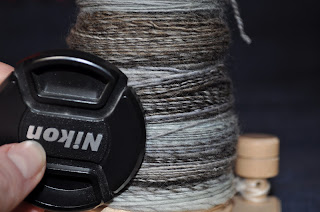 The experiment part comes next. On her blog, Erica has occasionally shown braids of some of her colorways wound together (that temptress); she made the mistake of showing Misty Water with a braid of BFL in SeaGreen, and I snapped them both up.
 The plan is to ply them together, which isn't so experimental. But the plan is also to spin the BFL worsted, which is the kind of spinning that BFL seems to me to cry out for (all that lovely shine just gets maximized that way). So the hope is that I'll end up with something that blends the traits of that warm, light, fuzzy Polwarth with the long, strong, shiny BFL. Stay tuned.
The more I get to try different fibers, the more I'm intrigued by immense range of texture and function that the fiber world offers. So when I saw that Ellen and Jan had each gotten a sampler of fiber from Woolgatherings, I jumped on the bandwagon (they are kind enough to not seem to mind).
 And that's not the half of it! There's a whole other layer in there - 24 total.
I made Rick stand and feel each one while I told him their names (he, too, is a patient person who humors me). The names make me so unutterably happy I can't tell you - how can one not be excited about fiber like Shetland Humbug? I mean, really. The plan is to choose a couple of these each month to research and spin up, and to compare notes with Jan and Ellen. I am really looking forward to it. I'm teaching a class at my LYS on the 17th on getting to know one's fiber, both for making good yarn/project pairings (for knitters) and for spinners who want to think about the range of fiber possibilities available to them. As an inspiration for me, Erica sent me a huge bag of all kinds of wonderful fibers I'd never seen or touched before, and I'll be showing those off to students (I need to get a picture of that, too). So while I'm hoping I might inspire some local folks to take an interest in playing with me, I don't have a study group like that yet - I love that I have a long-distance one, with people who are asnuts weird interested in learning new things as I.
And speaking of ranges of possibilities and fabulous names, look at what I'm knitting right now.
 That is Rams and Yowes, a lap blanket pattern by Kate Davies, she of the famous Sheepheid (which I also now have yarn to knit). I love that she wrote both patterns to celebrate the immense diversity of colors of Shetland wool - the blanket has nine different colors. And oh, the names! We've got gaulmogot, and mooskit, shaela, and yuglet. I (naturally) started poking around, looking for etymologies of the names, but only have been able to find information for two: sholmit and moorit (if anyone knows about any of the others, please, please let me know!). Sholmit comes from a Gaelic word meaning "Having a white face, as of ox or cow"; and moorit comes from a root morand-r, meaning "brown mingled with black and red" - it is cognate with English murrey, and French moree, and comes from an older root mor-.
Wool and language all mixed together. It just doesn't get much better than that.
I still don't have any shots of me actually wearing Poplar and Elm (although people have seen me wearing it, so it does exist). With luck, that will happen this weekend, when Rick is around to take actual pictures. Having Rick around is also a prerequisite to getting a picture of the first Blunnie Sock, which I have finished (no-one else's feet are even close to big enough to model his socks)(I should also say that I immediately cast on for the second sock in order to ward off the dreaded SSS). Nevertheless, there are other interesting things to show off.
I have been spinning, off and on. Spinning makes me happy. I got through this:


The more I get to try different fibers, the more I'm intrigued by immense range of texture and function that the fiber world offers. So when I saw that Ellen and Jan had each gotten a sampler of fiber from Woolgatherings, I jumped on the bandwagon (they are kind enough to not seem to mind).

I made Rick stand and feel each one while I told him their names (he, too, is a patient person who humors me). The names make me so unutterably happy I can't tell you - how can one not be excited about fiber like Shetland Humbug? I mean, really. The plan is to choose a couple of these each month to research and spin up, and to compare notes with Jan and Ellen. I am really looking forward to it. I'm teaching a class at my LYS on the 17th on getting to know one's fiber, both for making good yarn/project pairings (for knitters) and for spinners who want to think about the range of fiber possibilities available to them. As an inspiration for me, Erica sent me a huge bag of all kinds of wonderful fibers I'd never seen or touched before, and I'll be showing those off to students (I need to get a picture of that, too). So while I'm hoping I might inspire some local folks to take an interest in playing with me, I don't have a study group like that yet - I love that I have a long-distance one, with people who are as
And speaking of ranges of possibilities and fabulous names, look at what I'm knitting right now.

Wool and language all mixed together. It just doesn't get much better than that.
Tuesday, December 13, 2011
Knitting and linguistics
So. I think I said in my last post that, in our conversation during her class, Cat described to me the way she's been thinking about knitting in terms of linguistics. Needless to say, I loved it. So (because I like to share the things I love), I thought I'd try to explain the whole thing here, and see what you all think. This means that there is going to be a linguistics lesson. This is, in fact, a very fibery sort of post, in the sense that (if it all goes well), we'll be talking about knitting by the end, and talking about it analytically, but if linguistics isn't your thing, I completely understand. Next time, there will be pictures of knitted objects and spun yarn (yes, I have been spinning!). Note, you will need to say things out loud during the reading of this blog post - shut your office door, if necessary.
I'm going to lay out what we said in class in brief, just to kick things off, and then back up and define the main linguistic terms. Then I'll go at the linguistics/knitting thing again, except it will be clearer, and you can (and should!) join in the fun. (I should say that there is just no way to do this justice in one blog post - this is just sort of a kick-off.) In essence, Cat said that she was intrigued by the linguistic unit of the "phoneme", and thought that it could apply to knitting. I even wrote to Cat to make sure that I remembered what she said about how that would work (by the way, can I just tell you how much fun it is to meet someone who's as enthusiastic about thinking this way as I could ever hope to be, and who is totally willing to talk to me about it, even though I'm sure she's crazy busy?): "Any unit of stitch manipulation that could be placed into or removed from a piece of knitting to alter its appearance/ texture. This would include single-stitch units such as knit, purl, yo, etc., as well as larger horizontal units like cables and larger vertical units like slipped stitches, etc. What seems essential is that each unit, whether simple or complex, carry its own distinct identity/meaning (thus morpheme is better than phoneme)." That last bit is because when she expressed this idea to another linguist in another class, that person suggested that the idea of "morpheme" might better capture what she was thinking.
And so beginneth the lesson. First, the "phoneme". Phonemes are defined as units of sound in a particular language. The main idea to get here is that speakers of particular languages treat sounds which are, acoustically, different from one another as if they were the same. In doing so, they are acting out an unconscious agreement among the speakers of that language that those variants will not change the meanings of words if they are changed. So, for example, in English, we use a sound which I will represent with the symbol [t] (a linguist would say that this symbol stands for a sound which is described as a "voiceless alveolar stop"). You can hear that sound in a word like "stop"; it is the second sound in that word. (I won't get into it in too much detail here, but it is absolutely critical to remember that spelling is NOT language, and that we are talking here about SOUNDS, not about the way those sounds are represented alphabetically.) There is another sound in English that is very similar - it is represented by linguists as a [t] with a little superscript "h", which I can't make Blogger do, so we'll call it "aspirated t", which is what it is. It is very much like the first [t], except that it has a little puff of air associated with it - you can feel that if you say the word "top". Feel how there's a much bigger puff of air when you say the [t] in "top" than when you say it in "stop"?
Now. You tell me. Would you consider those two sounds (and believe me, acoustically, they are definitely two sounds) to be two different sounds, or simply variants of the same sound? In other words, are they as different as [d] and [t], or not? Note that [d] and [t] are "different" enough to speakers of English that they will distinguish between words - for example "dill" and "till". But would [t] and aspirated [t] do that?
Most native English speakers will, at this point, either say "no", or they'll look at me like I'm nuts for even asking ("duh" being a stronger version of "no"). For English speakers [t] and aspirated [t] are simply variants of the "same" sound, while [t] and [d] are "different" sounds. (But make the sounds [t] and [d] for a second, paying very close attention, and notice how similar they are. Acoustically and articulatorily - the way you move your mouth - they are as similar as [t] and aspirated [t] are; [t] is a voiceless alveolar stop, and [d] is a voiced alveolar stop - the only difference between them is whether your vocal cords are vibrating or not. Cool, huh?) This is specific to English - some languages view [t] and aspirated [t] as being utterly distinct sounds, as different as [t] and [d] and just as able to distinguish between words (Bengali is an example of one such language). But for English, the sounds [t] and aspirated [t] are variants of what we consider to be "one sound" - linguists call that "one sound" a phoneme, and we call its variants "allophones".
One way to think about it is this. Clark Kent and Superman are really the same guy, right? I mean, they look really different from one another, and they always show up in entirely different environments, but they're variants of one person - [t] and aspirated [t] are the same way. When he's at home, alone, with no-one to see him, who is this Clark Kent/Superman guy, anyway? He's the phoneme. And Clark Kent and Superman are his allophones. They are variants whose appearance is conditioned by environments - Clark Kent writes newspaper articles and pines after Lois Lane, and Superman gets to save the world. In the same way, aspirated [t] appears by itself at the beginning of words, and [t] appears in other places in words. (It's more complicated than that, but I'm simplifying.)
(For another fun exercise, say these pairs of words: beet/bead; etch/edge; bus/buzz; block/blog. Do you notice that in each pair, there is one word where the vowel in the middle is just a little longer than in the other word in the pair? Do you notice it's always the second word that has the longer vowel? Those vowels - short and long - don't distinguish between words in English (if you say "beeeet", you'll just sound like you're emphasizing the fact that you're talking about beets rather than turnips), but they are distinct from one another. Long and short vowels are allophones in English. There are other languages - like Kawaiisu - where short and long vowels are distinctive phonemes in the language - they will distinguish between words.)
Phonemes have no meaning by themselves. But by contrasting with one another, they can create meaning within words - no English speaker will confuse words like "till" and "dill". So, phonemes are minimal sound units within a particular language. They are building blocks, but by themselves they mean nothing. And phonemes have variant forms which cannot create meaning distinctions.
Now we move to morphemes. Morphemes are defined in linguistics as "minimal meaning units" - the smallest bits of language that have meaning. In a word like "cats", there are two morphemes - the morpheme "cat", which means furry thing with whiskers that purrs, and the morpheme "-s", which means more than one of whatever it's attached to. Morphemes, too, have variant forms (we call them "allomorphs"). In the case of the plural morpheme in English, there are three variant forms - pay very close attention to the way you pronounce the plural morpheme at the end of the words "cats", "dogs", and "churches". Really, really close attention. If you do (and it can help if you put them in front of another word, like "are", in a sentence), you'll notice that in the first one, we pronounce the morpheme [s], in the second [z], and in the third, something like [ez] (for any linguists out there, I'm sorry - I can't make Blogger speak IPA). Cool, huh? But we wouldn't want to say that there are three different bits that mean "plural" - we'd want to say that these are just variants of the "same" plural morpheme - they are allomorphs of the plural morpheme. (There are lots of other examples, but just by way of one more, think about words like "impossible", and "intangible" and "inconceivable" - if you pay close attention, you'll hear that you say that last one, in casual speech, more like "ingconceivable". That prefix im/in/ing-, meaning "not so much", has three allomorphs.)
OK. Back to knitting. The question is, are there units of knitting that are comparable to phonemes and morphemes? Are there units which are basic building blocks of the language of knitting, with variant forms, which don't have meaning in themselves? And are there other units (again, with variant forms) which do have some kind of "meaning"? Looking even more broadly, is there a knitting syntax? A way of combining larger and larger units of knitting to make "sentences" and even "narratives"?
After much contemplation (probably more than I should admit to, given that it's not even been two weeks since Cat dropped this lovely little cognitive plaything on me), I think that the knit stitch is a phoneme. I think it has two allophones: the regular knit stitch, and the twisted knit stitch. I think that the knit stitch contrasts with another phoneme, the purl stitch. I don't think that either a single knit stitch nor a single purl stitch has meaning in itself, but I do think that they contrast with one another in larger knitted structures. I also tend to think that a yo is a phoneme. And maybe decreases and increases are phonemes, and the different kinds of, say, decreases are allophones of one phoneme. In other words, a k2tog and an ssk will not distinguish different meanings within a knitted structure, but either one will contrast with a kfb or a M1.
I think that things like k2,p2 would be a morpheme - the "ribbing" morpheme. I think that it's a morpheme because when stitches combine like that, they have a meaning within a knitted structure. I also think that that morpheme has allomorphs, like the k1,p1 allomorph, or the k2tbl, p2 allomorph. I'm wondering whether cables are morphemes, and at what point is one cable different enough from another that they're two different meaning units? And, are small cables surrounded by purl stitches simply allomorphs of the ribbing morpheme, or something else?
And should we be calling these something else? Alloknits and allomotifs? Or...?
I love this analogy. It's making me think about what kinds of "meanings" are recognizable in our knitting, and I do think that there is such a thing. When we see someone else's knitted garments, we know what they're trying to do. We may not always find whatever it is appealing, nor think that it's the best way to convey a particular "meaning", but it's recognizable. This is very much the same way that a syntactically appropriate sentence of English may be appealing to some speakers, while others think, "I wouldn't say it that way." But it is recognizable as English, and it is recognizable because it follows the rules of the language which are acquired, unconsciously, by all native English speakers (I do not speak here of eighth-grade grammar class rules, which aren't the rules that linguists are interested in). I do think, though, that there comes a point where this analogy may break down. The combination of morphemes into words, and words into sentences, is subject to a pretty stringent and inflexible (all things considered) set of rules. But that doesn't seem to be the case in knitting, at least not when it comes to knitted motifs (although probably when it comes to bits of garments - for example, you wouldn't want to put a sock cuff on the toe).
And maybe that's the best bit about knitting? It's rule-governed, but not rule-bound. I think I like that.
I'm going to lay out what we said in class in brief, just to kick things off, and then back up and define the main linguistic terms. Then I'll go at the linguistics/knitting thing again, except it will be clearer, and you can (and should!) join in the fun. (I should say that there is just no way to do this justice in one blog post - this is just sort of a kick-off.) In essence, Cat said that she was intrigued by the linguistic unit of the "phoneme", and thought that it could apply to knitting. I even wrote to Cat to make sure that I remembered what she said about how that would work (by the way, can I just tell you how much fun it is to meet someone who's as enthusiastic about thinking this way as I could ever hope to be, and who is totally willing to talk to me about it, even though I'm sure she's crazy busy?): "Any unit of stitch manipulation that could be placed into or removed from a piece of knitting to alter its appearance/ texture. This would include single-stitch units such as knit, purl, yo, etc., as well as larger horizontal units like cables and larger vertical units like slipped stitches, etc. What seems essential is that each unit, whether simple or complex, carry its own distinct identity/meaning (thus morpheme is better than phoneme)." That last bit is because when she expressed this idea to another linguist in another class, that person suggested that the idea of "morpheme" might better capture what she was thinking.
And so beginneth the lesson. First, the "phoneme". Phonemes are defined as units of sound in a particular language. The main idea to get here is that speakers of particular languages treat sounds which are, acoustically, different from one another as if they were the same. In doing so, they are acting out an unconscious agreement among the speakers of that language that those variants will not change the meanings of words if they are changed. So, for example, in English, we use a sound which I will represent with the symbol [t] (a linguist would say that this symbol stands for a sound which is described as a "voiceless alveolar stop"). You can hear that sound in a word like "stop"; it is the second sound in that word. (I won't get into it in too much detail here, but it is absolutely critical to remember that spelling is NOT language, and that we are talking here about SOUNDS, not about the way those sounds are represented alphabetically.) There is another sound in English that is very similar - it is represented by linguists as a [t] with a little superscript "h", which I can't make Blogger do, so we'll call it "aspirated t", which is what it is. It is very much like the first [t], except that it has a little puff of air associated with it - you can feel that if you say the word "top". Feel how there's a much bigger puff of air when you say the [t] in "top" than when you say it in "stop"?
Now. You tell me. Would you consider those two sounds (and believe me, acoustically, they are definitely two sounds) to be two different sounds, or simply variants of the same sound? In other words, are they as different as [d] and [t], or not? Note that [d] and [t] are "different" enough to speakers of English that they will distinguish between words - for example "dill" and "till". But would [t] and aspirated [t] do that?
Most native English speakers will, at this point, either say "no", or they'll look at me like I'm nuts for even asking ("duh" being a stronger version of "no"). For English speakers [t] and aspirated [t] are simply variants of the "same" sound, while [t] and [d] are "different" sounds. (But make the sounds [t] and [d] for a second, paying very close attention, and notice how similar they are. Acoustically and articulatorily - the way you move your mouth - they are as similar as [t] and aspirated [t] are; [t] is a voiceless alveolar stop, and [d] is a voiced alveolar stop - the only difference between them is whether your vocal cords are vibrating or not. Cool, huh?) This is specific to English - some languages view [t] and aspirated [t] as being utterly distinct sounds, as different as [t] and [d] and just as able to distinguish between words (Bengali is an example of one such language). But for English, the sounds [t] and aspirated [t] are variants of what we consider to be "one sound" - linguists call that "one sound" a phoneme, and we call its variants "allophones".
One way to think about it is this. Clark Kent and Superman are really the same guy, right? I mean, they look really different from one another, and they always show up in entirely different environments, but they're variants of one person - [t] and aspirated [t] are the same way. When he's at home, alone, with no-one to see him, who is this Clark Kent/Superman guy, anyway? He's the phoneme. And Clark Kent and Superman are his allophones. They are variants whose appearance is conditioned by environments - Clark Kent writes newspaper articles and pines after Lois Lane, and Superman gets to save the world. In the same way, aspirated [t] appears by itself at the beginning of words, and [t] appears in other places in words. (It's more complicated than that, but I'm simplifying.)
(For another fun exercise, say these pairs of words: beet/bead; etch/edge; bus/buzz; block/blog. Do you notice that in each pair, there is one word where the vowel in the middle is just a little longer than in the other word in the pair? Do you notice it's always the second word that has the longer vowel? Those vowels - short and long - don't distinguish between words in English (if you say "beeeet", you'll just sound like you're emphasizing the fact that you're talking about beets rather than turnips), but they are distinct from one another. Long and short vowels are allophones in English. There are other languages - like Kawaiisu - where short and long vowels are distinctive phonemes in the language - they will distinguish between words.)
Phonemes have no meaning by themselves. But by contrasting with one another, they can create meaning within words - no English speaker will confuse words like "till" and "dill". So, phonemes are minimal sound units within a particular language. They are building blocks, but by themselves they mean nothing. And phonemes have variant forms which cannot create meaning distinctions.
Now we move to morphemes. Morphemes are defined in linguistics as "minimal meaning units" - the smallest bits of language that have meaning. In a word like "cats", there are two morphemes - the morpheme "cat", which means furry thing with whiskers that purrs, and the morpheme "-s", which means more than one of whatever it's attached to. Morphemes, too, have variant forms (we call them "allomorphs"). In the case of the plural morpheme in English, there are three variant forms - pay very close attention to the way you pronounce the plural morpheme at the end of the words "cats", "dogs", and "churches". Really, really close attention. If you do (and it can help if you put them in front of another word, like "are", in a sentence), you'll notice that in the first one, we pronounce the morpheme [s], in the second [z], and in the third, something like [ez] (for any linguists out there, I'm sorry - I can't make Blogger speak IPA). Cool, huh? But we wouldn't want to say that there are three different bits that mean "plural" - we'd want to say that these are just variants of the "same" plural morpheme - they are allomorphs of the plural morpheme. (There are lots of other examples, but just by way of one more, think about words like "impossible", and "intangible" and "inconceivable" - if you pay close attention, you'll hear that you say that last one, in casual speech, more like "ingconceivable". That prefix im/in/ing-, meaning "not so much", has three allomorphs.)
OK. Back to knitting. The question is, are there units of knitting that are comparable to phonemes and morphemes? Are there units which are basic building blocks of the language of knitting, with variant forms, which don't have meaning in themselves? And are there other units (again, with variant forms) which do have some kind of "meaning"? Looking even more broadly, is there a knitting syntax? A way of combining larger and larger units of knitting to make "sentences" and even "narratives"?
After much contemplation (probably more than I should admit to, given that it's not even been two weeks since Cat dropped this lovely little cognitive plaything on me), I think that the knit stitch is a phoneme. I think it has two allophones: the regular knit stitch, and the twisted knit stitch. I think that the knit stitch contrasts with another phoneme, the purl stitch. I don't think that either a single knit stitch nor a single purl stitch has meaning in itself, but I do think that they contrast with one another in larger knitted structures. I also tend to think that a yo is a phoneme. And maybe decreases and increases are phonemes, and the different kinds of, say, decreases are allophones of one phoneme. In other words, a k2tog and an ssk will not distinguish different meanings within a knitted structure, but either one will contrast with a kfb or a M1.
I think that things like k2,p2 would be a morpheme - the "ribbing" morpheme. I think that it's a morpheme because when stitches combine like that, they have a meaning within a knitted structure. I also think that that morpheme has allomorphs, like the k1,p1 allomorph, or the k2tbl, p2 allomorph. I'm wondering whether cables are morphemes, and at what point is one cable different enough from another that they're two different meaning units? And, are small cables surrounded by purl stitches simply allomorphs of the ribbing morpheme, or something else?
And should we be calling these something else? Alloknits and allomotifs? Or...?
I love this analogy. It's making me think about what kinds of "meanings" are recognizable in our knitting, and I do think that there is such a thing. When we see someone else's knitted garments, we know what they're trying to do. We may not always find whatever it is appealing, nor think that it's the best way to convey a particular "meaning", but it's recognizable. This is very much the same way that a syntactically appropriate sentence of English may be appealing to some speakers, while others think, "I wouldn't say it that way." But it is recognizable as English, and it is recognizable because it follows the rules of the language which are acquired, unconsciously, by all native English speakers (I do not speak here of eighth-grade grammar class rules, which aren't the rules that linguists are interested in). I do think, though, that there comes a point where this analogy may break down. The combination of morphemes into words, and words into sentences, is subject to a pretty stringent and inflexible (all things considered) set of rules. But that doesn't seem to be the case in knitting, at least not when it comes to knitted motifs (although probably when it comes to bits of garments - for example, you wouldn't want to put a sock cuff on the toe).
And maybe that's the best bit about knitting? It's rule-governed, but not rule-bound. I think I like that.
Monday, December 6, 2010
A link for your entertainment
I have much to report, and little time to report it. This is the last week of classes, and then it's all marking papers until grades are due on the 22nd. But Beverly just sent me this link, and it made me so happy I had to share.
Linguists. Singing. About theory. It just doesn't get a lot better than that.
Next time: knitting. I promise.
Linguists. Singing. About theory. It just doesn't get a lot better than that.
Next time: knitting. I promise.
Tuesday, August 3, 2010
Verbal knitting
I went north, and I have returned. (Go north, not-so-young woman, go north!)
(It doesn't have the same ring, does it?)
It was a wonderful weekend. I learned not only the ten assigned verbs plus three endings (more aspectual endings than tense, I think, even though everyone persists in understanding them as tense)(and if that interests anyone, I would happily do the brief tense/mood/aspect discussion with regard to verbs some time; always willing, always willing), but two more verbs to boot! And one of them I even intuited based on the data provided during the learning of the first eleven. Man, did I feel good.
But even better was the fact that everyone else seemed to learn them, too. (One should expect that a linguist could learn a few verb endings if push really came to shove; the real test of a good set of immersion lessons is whether they can capture and hold anyone's attention, and whether people walk away with useful and useable language. People did.) This was a three-day language camp for a language that currently has three native speakers (native in the sense of growing up speaking the language as a first language; they also happen to be Native), as well as a couple of pretty fluent second language speakers. There were a good fifteen or so of us at the camp, across at least three generations, and we all declared it a success.
 On the two mornings that I was there, I even got to go on a quick hike with Laura, the amazing woman who not only hosted this event, but who also finds all the grants that keep this project (and several others like it) going. I have absolutely NO idea how she does it, since I am a grant anti-magnet, but she writes them and manages them beautifully, and we are all grateful beyond belief. She's also wonderful company (and enjoys a good beer at the end of a long and language-filled day), and she takes me on good hikes with her dogs.
 It is the sepia season here in California. I wish I could paint...
Our walk took us up a drainage (long since dammed, alas), near which there are grinding stones, very likely used by the Kawaiisu people who were the forebears of the folks in that first picture up there.
 I can imagine women looking out at the view from that rock on a morning like this, watching the light come through the trees.
 There are still a myriad of oaks in the valley.

It turns out that language camps are also good for knitting. I finished the first of the pair of socks I'm working on for Younger Daughter. She is delighted.
 I was inspired to knit these after seeing Lori's. (I can't find the exact post, for some reason, but here's her Rav project.) They're the Circle Socks, and since I was rather winging the pattern from some scribbled notes I'd made, these are a little different from the actual pattern. Younger Daughter is pretty happy with them, though; she says they look like fish, and they really do, don't they? Lovely bright tropical fish. They are very "her".
 I have knitted mine out of Jitterbug, on size one needles. Had I had all of my needles with me, I might optimally have gone up a needle size, but this worked out well enough. I knitted them over 56 stitches, and made the foot a bit wider than the leg (62 stitches). The heel is eye of partridge. I broke my cardinal rule, though, and did not cast on for the second sock as soon as I'd cast off the first, so I must go tonight and remedy that, lest I neglect to get these done.
Next time, lace.
(It doesn't have the same ring, does it?)
It was a wonderful weekend. I learned not only the ten assigned verbs plus three endings (more aspectual endings than tense, I think, even though everyone persists in understanding them as tense)(and if that interests anyone, I would happily do the brief tense/mood/aspect discussion with regard to verbs some time; always willing, always willing), but two more verbs to boot! And one of them I even intuited based on the data provided during the learning of the first eleven. Man, did I feel good.
But even better was the fact that everyone else seemed to learn them, too. (One should expect that a linguist could learn a few verb endings if push really came to shove; the real test of a good set of immersion lessons is whether they can capture and hold anyone's attention, and whether people walk away with useful and useable language. People did.) This was a three-day language camp for a language that currently has three native speakers (native in the sense of growing up speaking the language as a first language; they also happen to be Native), as well as a couple of pretty fluent second language speakers. There were a good fifteen or so of us at the camp, across at least three generations, and we all declared it a success.
 On the two mornings that I was there, I even got to go on a quick hike with Laura, the amazing woman who not only hosted this event, but who also finds all the grants that keep this project (and several others like it) going. I have absolutely NO idea how she does it, since I am a grant anti-magnet, but she writes them and manages them beautifully, and we are all grateful beyond belief. She's also wonderful company (and enjoys a good beer at the end of a long and language-filled day), and she takes me on good hikes with her dogs.
 It is the sepia season here in California. I wish I could paint...
Our walk took us up a drainage (long since dammed, alas), near which there are grinding stones, very likely used by the Kawaiisu people who were the forebears of the folks in that first picture up there.
 I can imagine women looking out at the view from that rock on a morning like this, watching the light come through the trees.
 There are still a myriad of oaks in the valley.
It turns out that language camps are also good for knitting. I finished the first of the pair of socks I'm working on for Younger Daughter. She is delighted.
 I was inspired to knit these after seeing Lori's. (I can't find the exact post, for some reason, but here's her Rav project.) They're the Circle Socks, and since I was rather winging the pattern from some scribbled notes I'd made, these are a little different from the actual pattern. Younger Daughter is pretty happy with them, though; she says they look like fish, and they really do, don't they? Lovely bright tropical fish. They are very "her".
 I have knitted mine out of Jitterbug, on size one needles. Had I had all of my needles with me, I might optimally have gone up a needle size, but this worked out well enough. I knitted them over 56 stitches, and made the foot a bit wider than the leg (62 stitches). The heel is eye of partridge. I broke my cardinal rule, though, and did not cast on for the second sock as soon as I'd cast off the first, so I must go tonight and remedy that, lest I neglect to get these done.
Next time, lace.
Monday, April 12, 2010
Where does the time go?
Do you think if I offered a reward, someone would find me some time? How did a week go by without me having a single chance to sit down and post?
Well, I actually know how the week went by -- busily -- but it still seems like I should have been able to write a quick something.
In any case, part of the reason why my evenings, at least, were taken up was because I was spinning like a fiend, wanting desperately to finish spinning and plying the Wensleydale I showed you all last time. I divided the four ounces of fiber into three bumps (I even weighed them to be sure I divided it all up nicely), trying to keep the same colors in each bump. I then spun three bobbins of singles, very fine with lots of twist, as I knew I wanted a high-twist sock yarn.
 The plan was to finish this up on Wednesday night so I could soak the skein and hang it to dry on Thursday morning, so I could wind it up and pack it to take with me this weekend (more on that below). I did, in fact, almost finish plying on Wednesday night, then got up early to get the last bit done on Thursday morning. I skeined and soaked it while handling some phone calls on Thursday and hung it to dry. Alas, I have no pictures (I promise I'll post some this week), but it did turn out beautifully, about 20 wpi and nearly 300 yards, and a gorgeous heathery purple color. The sad thing is that the yarn feels like it would be too stiff to make good socks. Sigh. I'm not sure if it's because the Wensleydale just isn't cut out to be good sock wool (it's a longwool, so on the coarser side), or if I overspun it to start; maybe if I hadn't spun it worsted? But woollen-spun yarn doesn't make for the best socks. In any case, I think it will make a lovely piece of lace, with really nice stitch definition, and it's already wound up in a ball, so I'll have to find the right pattern for it.
I also, during a number of very long and otherwise annoying meetings last week, finished Damson. I have (anyone care to guess what I'm going to say here?) no new pictures of that either, but I'm hoping to do a quick blocking tonight so I can wear it tomorrow. Just to remind you, it's this project:
 I'm really happy with the way it turned out, and I think it's going to be the perfect spring shawlet. It's also the shape that I've recently come to appreciate most in neckwear: a shallow triangle that can be worn either as a small shawl, or wrapped multiple times around the neck as a scarf.
Part of the reason why my week was so rushed was because I knew that I had to be ready for another working weekend (warning: linguistics incoming). This past weekend, I took the girls with me up to Wonder Valley (east of Fresno, more or less; about a six-hour drive, depending on LA traffic) for a Master-Apprentice training. The Master-Apprentice program is one of my very favorite language revitalization programs (I'm biased), and I've been lucky enough to be involved with it, one way and another, since one of my graduate advisors first got me involved some fifteen years ago. I don't know if I've mentioned before, but California (prior to European contact) was one of the most linguistically diverse areas in the world, with over 100 separate languages (plus their assorted dialects) spoken inside what are now the state borders. That's a lot. (Just FYI, there are about 6,000 languages spoken in the world today.) But, because of its long history of contact, fewer than 50 of those languages are still spoken today, and almost all of them have fewer than 10 speakers still living (many as few as one speaker), and most of those speakers are elderly.
So, Californians who wanted to revitalize their languages of heritage looked to successful programs around the world. Some of the most successful are the revitalization of Hebrew in Israel, Maori in New Zealand, Hawaiian in Hawai'i, and languages like Welsh and Irish in Britain and Ireland. In each of those situations, though, there was only one language upon which to focus available resources and (except for Hebrew, which is a different sort of case for a number of reasons), there were still (at the least) hundreds of speakers, many of whom were still relatively young (by which I mean 50s and 60s). Not so in California. So people here looked to those programs, and took their successes and adapted them. We couldn't easily credential elder speakers to work in classrooms, nor could they easily raise children in the language (obviously), and we couldn't count on university support to develop curriculum (languages like Maori and Hawaiian were taught as second languages in universities even before the language revitalization movements gained ground; that hadn't happened here), so the Master-Apprentice program was developed to recreate a natural learning situation between one elder speaker (a master) and one younger learner (the apprentice) who could then go on to teach the language to his or her children, and/or in classrooms.
It's not easy, though. Each pair has to essentially recreate, on an ongoing basis, an immersion situation within a speech community of two. And each apprentice has to willingly re-live the language acquisition process, going through all of those stages that each of us goes through in our first language(s) (read: sounding silly, getting words wrong, not being able to articulate the thoughts in our heads; much of that is very cute in young children, but doesn't feel so cute when one is an adult). So the program holds trainings, where we talk about how to create that immersion situation, how to leave English behind, how to work as a master to teach the language this way, and as an apprentice to learn it. But the trainings are always more than that.
Doing this kind of language work is almost impossible to describe to people who have never tried it, especially if they've never tried it with languages which are this endangered. It's one thing if I don't learn my mother's first language (French); I can count on all of those people in France to keep speaking it for me. But apprentices feel the ever-present weight of their community's expectations and desires, not to mention the weight of their own expectations, and those of their masters. And masters feel the pressure of knowing that if they do not successfully pass the language on to their apprentices, no one else can. These teams are brave in a way that I have rarely seen. So the trainings are a safe space to talk about that. To celebrate successes, and to grieve the difficulties. To talk about all of the reasons why each and every person involved in the program is sticking with it in the face of seemingly insurmountable odds. They're also a place to laugh and cry, to tell stories happy and sad, and (this weekend at least) to learn some pretty fun traditional games (my face hurt with laughing by the end of Saturday).
It's an honor to be allowed to be involved, to have the participants make space for me as a linguist to be there, and to welcome my children with me. And it's unreal to see how much progress people have made since the program started. I know apprentices who are now masters of their own teams, who are raising their children using their languages of heritage as first languages in the home, who are teaching immersion techniques at these trainings themselves. I did part of the training on Saturday morning with a young woman who was about eight years old when I first met her, and who now is a fluent speaker of her language, working to take her tribe through the next steps of reclaiming their language as a community language for everyone.
Weekends like this remind me of why I do what I do, and of who and what matters in the process.
Now if only I'd remembered my camera...
Well, I actually know how the week went by -- busily -- but it still seems like I should have been able to write a quick something.
In any case, part of the reason why my evenings, at least, were taken up was because I was spinning like a fiend, wanting desperately to finish spinning and plying the Wensleydale I showed you all last time. I divided the four ounces of fiber into three bumps (I even weighed them to be sure I divided it all up nicely), trying to keep the same colors in each bump. I then spun three bobbins of singles, very fine with lots of twist, as I knew I wanted a high-twist sock yarn.
 The plan was to finish this up on Wednesday night so I could soak the skein and hang it to dry on Thursday morning, so I could wind it up and pack it to take with me this weekend (more on that below). I did, in fact, almost finish plying on Wednesday night, then got up early to get the last bit done on Thursday morning. I skeined and soaked it while handling some phone calls on Thursday and hung it to dry. Alas, I have no pictures (I promise I'll post some this week), but it did turn out beautifully, about 20 wpi and nearly 300 yards, and a gorgeous heathery purple color. The sad thing is that the yarn feels like it would be too stiff to make good socks. Sigh. I'm not sure if it's because the Wensleydale just isn't cut out to be good sock wool (it's a longwool, so on the coarser side), or if I overspun it to start; maybe if I hadn't spun it worsted? But woollen-spun yarn doesn't make for the best socks. In any case, I think it will make a lovely piece of lace, with really nice stitch definition, and it's already wound up in a ball, so I'll have to find the right pattern for it.
I also, during a number of very long and otherwise annoying meetings last week, finished Damson. I have (anyone care to guess what I'm going to say here?) no new pictures of that either, but I'm hoping to do a quick blocking tonight so I can wear it tomorrow. Just to remind you, it's this project:
 I'm really happy with the way it turned out, and I think it's going to be the perfect spring shawlet. It's also the shape that I've recently come to appreciate most in neckwear: a shallow triangle that can be worn either as a small shawl, or wrapped multiple times around the neck as a scarf.
Part of the reason why my week was so rushed was because I knew that I had to be ready for another working weekend (warning: linguistics incoming). This past weekend, I took the girls with me up to Wonder Valley (east of Fresno, more or less; about a six-hour drive, depending on LA traffic) for a Master-Apprentice training. The Master-Apprentice program is one of my very favorite language revitalization programs (I'm biased), and I've been lucky enough to be involved with it, one way and another, since one of my graduate advisors first got me involved some fifteen years ago. I don't know if I've mentioned before, but California (prior to European contact) was one of the most linguistically diverse areas in the world, with over 100 separate languages (plus their assorted dialects) spoken inside what are now the state borders. That's a lot. (Just FYI, there are about 6,000 languages spoken in the world today.) But, because of its long history of contact, fewer than 50 of those languages are still spoken today, and almost all of them have fewer than 10 speakers still living (many as few as one speaker), and most of those speakers are elderly.
So, Californians who wanted to revitalize their languages of heritage looked to successful programs around the world. Some of the most successful are the revitalization of Hebrew in Israel, Maori in New Zealand, Hawaiian in Hawai'i, and languages like Welsh and Irish in Britain and Ireland. In each of those situations, though, there was only one language upon which to focus available resources and (except for Hebrew, which is a different sort of case for a number of reasons), there were still (at the least) hundreds of speakers, many of whom were still relatively young (by which I mean 50s and 60s). Not so in California. So people here looked to those programs, and took their successes and adapted them. We couldn't easily credential elder speakers to work in classrooms, nor could they easily raise children in the language (obviously), and we couldn't count on university support to develop curriculum (languages like Maori and Hawaiian were taught as second languages in universities even before the language revitalization movements gained ground; that hadn't happened here), so the Master-Apprentice program was developed to recreate a natural learning situation between one elder speaker (a master) and one younger learner (the apprentice) who could then go on to teach the language to his or her children, and/or in classrooms.
It's not easy, though. Each pair has to essentially recreate, on an ongoing basis, an immersion situation within a speech community of two. And each apprentice has to willingly re-live the language acquisition process, going through all of those stages that each of us goes through in our first language(s) (read: sounding silly, getting words wrong, not being able to articulate the thoughts in our heads; much of that is very cute in young children, but doesn't feel so cute when one is an adult). So the program holds trainings, where we talk about how to create that immersion situation, how to leave English behind, how to work as a master to teach the language this way, and as an apprentice to learn it. But the trainings are always more than that.
Doing this kind of language work is almost impossible to describe to people who have never tried it, especially if they've never tried it with languages which are this endangered. It's one thing if I don't learn my mother's first language (French); I can count on all of those people in France to keep speaking it for me. But apprentices feel the ever-present weight of their community's expectations and desires, not to mention the weight of their own expectations, and those of their masters. And masters feel the pressure of knowing that if they do not successfully pass the language on to their apprentices, no one else can. These teams are brave in a way that I have rarely seen. So the trainings are a safe space to talk about that. To celebrate successes, and to grieve the difficulties. To talk about all of the reasons why each and every person involved in the program is sticking with it in the face of seemingly insurmountable odds. They're also a place to laugh and cry, to tell stories happy and sad, and (this weekend at least) to learn some pretty fun traditional games (my face hurt with laughing by the end of Saturday).
It's an honor to be allowed to be involved, to have the participants make space for me as a linguist to be there, and to welcome my children with me. And it's unreal to see how much progress people have made since the program started. I know apprentices who are now masters of their own teams, who are raising their children using their languages of heritage as first languages in the home, who are teaching immersion techniques at these trainings themselves. I did part of the training on Saturday morning with a young woman who was about eight years old when I first met her, and who now is a fluent speaker of her language, working to take her tribe through the next steps of reclaiming their language as a community language for everyone.
Weekends like this remind me of why I do what I do, and of who and what matters in the process.
Now if only I'd remembered my camera...
Wednesday, March 24, 2010
I need to plan better
The last time I posted, I remember thinking to myself, "Dude, you should seriously save some of these project photos for the next time, when you'll have made no progress worth a darn. Then you'll have something to show off, all ready. Like a Tupperware of chili in the freezer."
Did I take my own advice? No, I did not.
I hope this makes anyone who's ever given me advice that I've ignored feel better; apparently, I do it to everyone, so you're in good company.
I have been knitting, though. Truly. I am almost done with the garter stitch section on Damson. And I am further along on the zigzag scarf (I don't like the name of that scarf in the book, so that's what I'm calling it). That has turned into excellent meeting knitting, and I took it with me up to Tehachapi for Sunday's language work, so progress is slow but steady. I have also been spinning. I am almost done with the first third of the roving I showed you last time. I decided to work on this one first:
 That is Wensleydale (in the Abalone colorway). Before buying it, I thought that was a cheese, but apparently it's also a sheep. (Related? I don't know, but now I'm going to have to find out.)(This will take some real research, because when I Wiki'd it, it only referred to the region. Nary a cheese nor a sheep in sight.) Kristine, from A Verb For Keeping Warm, recommended it highly when I told her that I was looking for fiber to spin into socks. And can I just tell you how much I'm absolutely loving this fiber? It is incredibly long-stapled, I'm guessing at least three inches, with almost no crimp, and it drafts like a dream. I'm putting in plenty of twist (which I find difficult, for some reason -- my hands want to product a loosely spun two-ply, somewhere between fingering and lace weight, and I'm trying here to produce a pretty fine singles, with very tight twist, so that I can end up with a tightly twisted fingering-weight three ply; we'll see how it goes), and it's taking it like a champ. I took the two hanks of fiber and broke each of them into thirds, keeping the colors in each third similar. We'll see how the final yarn turns out, but I'm having a lot of fun, and spinning each evening a little bit. I'm wondering whether it would be excessive to take my wheel along to Mammoth next week...
I also got myself a sock kit with which I am tremendously delighted. Check this out. How wonderful is that? I have a few modifications in mind, but mostly I'm going to knit them as they lie, and enjoy the completely over-the-top nature of those socks. So I need to wind that up and pack them to go on our trip.
Meanwhile, work continues. My field methods class is progressing beautifully. They were very brave, and over the last two weeks, four groups have worked together to elicit the Frog Story from our speaker. This sounds like an odd thing to do, but it's something that every linguist will recognize instantly. See, there's this book that Mercer Meyer illustrated years ago, called Frog, Where Are You. The entire book is pictures, no words, and the story is extremely active (it's about a little boy whose pet frog goes off hunting for some lovin', and the boy and his dog go out to find the frog and have many adventures before finding the frog with his lady frog and many froglets; the ending is happy, I promise). What this means from a linguist's perspective is that you can show this book to the speaker of another language, and ask them to narrate the story, in as much detail as you like, and you are guaranteed to get a story that is a) not influenced by translating from an English text, and b) has lots and lots of lovely verbs in it, because of all of the actions in the story. It's a staple of linguistic fieldwork. And that's exactly what happened here. Suddenly, all of the accusitive and genitive marking that I'd been waiting for in vain appeared out of nowhere, like mushrooms after a rain; we got verb tense marking up the wazoo, and a whole lot of other fun things, too.
It's also more fun for the students and for the speaker, I think, to be focusing on an actual narrative, rather than individual, unconnected sentences. But it is simultaneously hairier, in that you never know what's going to come at you from one sentence to the next. It's real language. We're lucky, in that we have an amazing speaker, who is both tremendously patient, and willing to work with the students as they analyze the sentences; in fact, I have to remind them not to rely on her too much, both because they need to do the work themselves, and because sometimes speakers either don't recognize some of the core phenomena of their languages (in fact, let's be honest, most speakers don't recognize most of the core phenomena of their languages), and sometimes what they've been taught about how language works is not, in fact, particularly accurate. In any case, my students all turned in their analyses of the story on Monday, and I've been having fun (honestly) reading them; with luck I'll have all of that done before we leave for spring break.
Did I take my own advice? No, I did not.
I hope this makes anyone who's ever given me advice that I've ignored feel better; apparently, I do it to everyone, so you're in good company.
I have been knitting, though. Truly. I am almost done with the garter stitch section on Damson. And I am further along on the zigzag scarf (I don't like the name of that scarf in the book, so that's what I'm calling it). That has turned into excellent meeting knitting, and I took it with me up to Tehachapi for Sunday's language work, so progress is slow but steady. I have also been spinning. I am almost done with the first third of the roving I showed you last time. I decided to work on this one first:
 That is Wensleydale (in the Abalone colorway). Before buying it, I thought that was a cheese, but apparently it's also a sheep. (Related? I don't know, but now I'm going to have to find out.)(This will take some real research, because when I Wiki'd it, it only referred to the region. Nary a cheese nor a sheep in sight.) Kristine, from A Verb For Keeping Warm, recommended it highly when I told her that I was looking for fiber to spin into socks. And can I just tell you how much I'm absolutely loving this fiber? It is incredibly long-stapled, I'm guessing at least three inches, with almost no crimp, and it drafts like a dream. I'm putting in plenty of twist (which I find difficult, for some reason -- my hands want to product a loosely spun two-ply, somewhere between fingering and lace weight, and I'm trying here to produce a pretty fine singles, with very tight twist, so that I can end up with a tightly twisted fingering-weight three ply; we'll see how it goes), and it's taking it like a champ. I took the two hanks of fiber and broke each of them into thirds, keeping the colors in each third similar. We'll see how the final yarn turns out, but I'm having a lot of fun, and spinning each evening a little bit. I'm wondering whether it would be excessive to take my wheel along to Mammoth next week...
I also got myself a sock kit with which I am tremendously delighted. Check this out. How wonderful is that? I have a few modifications in mind, but mostly I'm going to knit them as they lie, and enjoy the completely over-the-top nature of those socks. So I need to wind that up and pack them to go on our trip.
Meanwhile, work continues. My field methods class is progressing beautifully. They were very brave, and over the last two weeks, four groups have worked together to elicit the Frog Story from our speaker. This sounds like an odd thing to do, but it's something that every linguist will recognize instantly. See, there's this book that Mercer Meyer illustrated years ago, called Frog, Where Are You. The entire book is pictures, no words, and the story is extremely active (it's about a little boy whose pet frog goes off hunting for some lovin', and the boy and his dog go out to find the frog and have many adventures before finding the frog with his lady frog and many froglets; the ending is happy, I promise). What this means from a linguist's perspective is that you can show this book to the speaker of another language, and ask them to narrate the story, in as much detail as you like, and you are guaranteed to get a story that is a) not influenced by translating from an English text, and b) has lots and lots of lovely verbs in it, because of all of the actions in the story. It's a staple of linguistic fieldwork. And that's exactly what happened here. Suddenly, all of the accusitive and genitive marking that I'd been waiting for in vain appeared out of nowhere, like mushrooms after a rain; we got verb tense marking up the wazoo, and a whole lot of other fun things, too.
It's also more fun for the students and for the speaker, I think, to be focusing on an actual narrative, rather than individual, unconnected sentences. But it is simultaneously hairier, in that you never know what's going to come at you from one sentence to the next. It's real language. We're lucky, in that we have an amazing speaker, who is both tremendously patient, and willing to work with the students as they analyze the sentences; in fact, I have to remind them not to rely on her too much, both because they need to do the work themselves, and because sometimes speakers either don't recognize some of the core phenomena of their languages (in fact, let's be honest, most speakers don't recognize most of the core phenomena of their languages), and sometimes what they've been taught about how language works is not, in fact, particularly accurate. In any case, my students all turned in their analyses of the story on Monday, and I've been having fun (honestly) reading them; with luck I'll have all of that done before we leave for spring break.
Subscribe to:
Posts (Atom)