Another place where thinking about the second arrow has been interesting and helpful is in dealing with my health. At the moment, that has to do with having an autoimmune arthritis. (Or two: I put it this way because my initial diagnosis was seronegative RA. About seven or more months ago, I developed some patches of psoriasis, and my rheumatologist added psoriatic arthritis to the list - this is one potential course of the disease, to start with the arthritis and then move to psoriasis. I thought we'd changed diagnoses, but my PCP pointed out that overlapping and multiple diagnoses are possible, and that that hasn't been ruled out. At this stage, I find it easier to talk about autoimmune arthritis.)
The first arrow is pretty easy to notice. On many days (not all), joint pain, sometimes fatigue, weakness in my hands. Typing hurts. Those things are uncomfortable or outright painful.
But then there's the second arrow. That arrow takes the form of stories about how this is so awful and unfair; or about how it's only going to get worse; or about how frustrating and upsetting it is to not be able to open a jar, when I used to have the strongest hands in the house. They own the future - and it's always the most negative future possible: I won't be able to ride any more; if swimming hurts, and walking hurts, how will I ever get any exercise? And if I don't exercise, how will I sleep? How will my clothes fit? Those stories take me out of the present experience and into all kinds of things that haven't happened yet, and adds the misery of those things onto the discomfort and unhappiness of the current moment. Worse yet, they linger, clinging to my attention even when the current discomfort wanes, or when other, happier things might have caught my attention, were it not so bound up in offering energy to the rantings of the second arrow.
Recently, the first arrow has had to do with the drugs that I'm on. I'm experiencing what I believe to be some side effects from the big gun drug I take every week, and I'm preparing to go off that drug to see if a) the side effects abate, and b) we can find something that works without the side effects (and maybe even c) something that works better than this one to control inflammation and pain). The side effects range from annoying to pretty darned uncomfortable. But they're not (I'm assured) life-threatening in any way, and I'm mostly able to live with them.
The second arrow - boy howdy, are there second arrows around this one! I shouldn't be on these drugs, I should be able to control this through diet/willpower/energy work/sleep/exercise. My rheumatologist and cardiologist both think I'm nuts and are simply humoring me. The last time I went off this particular drug, I had to live with a pretty unfun flare - I don't like pain, I'm back to work full time, how will I manage if I enter into a flare and have to spent six hours on my feet and run back and forth across campus twice a day? What if I don't lose all the weight I gained on this drug and I'm just lazy and fat after all? What if my clothes and rings never fit again?
Do you see how crazy my second arrows are? Stories, fears, anticipation (or whatever the word is for negative anticipation - and why don't we have a word for that? Dread isn't quite right, although it's close. Maybe nonticipation? Antiticipation?). And those thoughts usually have the energy of a squirrel hyped up on amphetamines set loose in a nut store. They don't quit.
The first arrow is what it is. Pain happens to everyone. People get sick who don't deserve it. I'm part of everyone, and I'm not immune to life's ups and downs. I'm not going to get out of this one without getting hit by those first arrows. (Hell, I'm not going to get out of this one alive!)
But the second arrow? That one I have some leverage over. That one, I can look at and say, thank you for trying to keep me safe, but I've got this. Not always, not every time. But even sometimes is a good start. There's a spaciousness in refusing the second arrow, in trying not to pre-own the (not yet happened, maybe never will happen) suffering of the future. The first arrow is more than enough, thank you. I'll stick with that.
Showing posts with label life with RA. Show all posts
Showing posts with label life with RA. Show all posts
Tuesday, September 10, 2019

Wednesday, August 28, 2019
Day 48: Grace
This past weekend, we made a decision as a family (I'll keep the details vague for now) that turned out not to be a good decision. A very large part of the reason why it turned out not to be a good decision had to do with the fact that, while I was very clear about the commitment of time and energy that came along with our decision, I hadn't factored in my (new, not-so-improved) stamina levels. It was one of those situations where a limit that I didn't know I had came and smacked me right in the face.
It sucked.
I spent quite a bit of time telling myself that I could gut it out. When the sane voice in my head says, "I can't do this", that voice usually replies, "Of course you can!", which is technically true. But this time, that small, sane voice in my head agreed that yes, I could, but then asked: what would I have to give up in order to do that? Because I would. My energy levels are not inexhaustible. I mean, they never were, but the limit used to be a lot further out, and it also used to be the case that I could run on reserves for a while and then catch up later. I don't have the same level of reserves, it turns out.
So we reversed our decision. And that also sucked.
In all of that, while I did give myself permission and grace to cry uncle rather than gutting it out, I have also done a whole lot of self-denigrating blame. I haven't given myself much grace. Other people have stepped in and offered me the grace that I'm struggling with, and in so doing have also offered me a template for what it looks like to think about this through that lens.
In this sense, I think that this autoimmune diagnosis offers me a chance to (read: insists that I) come to grips with something that I have largely preferred to deny: that life is messy, I make mistakes, I am not in control of everything that happens.
Which also sucks. But it turns out that living as if those things weren't true comes with its own very particular sort of misery. The freedom of looking back at this last weekend, and, instead of thinking "man, am I an idiot", getting this tiny glimpse of, "well, life is messy and I didn't see that coming" - it's a very spacious sort of feeling. (Before my critical voice jumps up and down and insists that I damned well ought to have seen it coming!) Spacious is good. Spacious does not suck.
Grace.
It sucked.
I spent quite a bit of time telling myself that I could gut it out. When the sane voice in my head says, "I can't do this", that voice usually replies, "Of course you can!", which is technically true. But this time, that small, sane voice in my head agreed that yes, I could, but then asked: what would I have to give up in order to do that? Because I would. My energy levels are not inexhaustible. I mean, they never were, but the limit used to be a lot further out, and it also used to be the case that I could run on reserves for a while and then catch up later. I don't have the same level of reserves, it turns out.
So we reversed our decision. And that also sucked.
In all of that, while I did give myself permission and grace to cry uncle rather than gutting it out, I have also done a whole lot of self-denigrating blame. I haven't given myself much grace. Other people have stepped in and offered me the grace that I'm struggling with, and in so doing have also offered me a template for what it looks like to think about this through that lens.
In this sense, I think that this autoimmune diagnosis offers me a chance to (read: insists that I) come to grips with something that I have largely preferred to deny: that life is messy, I make mistakes, I am not in control of everything that happens.
Which also sucks. But it turns out that living as if those things weren't true comes with its own very particular sort of misery. The freedom of looking back at this last weekend, and, instead of thinking "man, am I an idiot", getting this tiny glimpse of, "well, life is messy and I didn't see that coming" - it's a very spacious sort of feeling. (Before my critical voice jumps up and down and insists that I damned well ought to have seen it coming!) Spacious is good. Spacious does not suck.
Grace.
Thursday, October 18, 2018
Energy
I wrote this post in my head last Thursday, and then life got in the way and it didn't actually make it onto the page.
I wrote it while on a lovely hike (Thursdays are my work at home day, so I have a bit more time to actually get my feet onto dirt) during which I felt so good that I actually - get this - ran a little bit. I can't tell you how long it's been since that happened. And as I was jogging along, feeling pretty good, it suddenly hit me - I was feeling pretty good! And then it hit me - that must mean that I've been feeling pretty not-good for a while, you know?
I know that seems like a weird thing to say, but this has happened to me enough times now that I recognize it. It happened during several major bouts of depression, after my back surgery, and, several times now, with RA.
The obvious onset of RA and diagnosis came pretty quickly for me - I was very lucky. In the spring of 2017, I visited Tess at Mount Holyoke, and I remember clearly being able to sit cross-legged on the bed, tuck my leg under me when I sat in a chair, and that I could hunker down to take photos of the ice on the long lake on campus. That was at the end of March. By May, I couldn't do any of those things. By June, and definitely into July, it was becoming so painful to hook and unhook my bra, or to pull a t-shirt off over my head, that I began to worry that I'd have to start asking Rick to help me dress and undress. I also found that if I sat for any length of time, getting up again was... well, let's just say it was really painful, and it took a few minutes for my hips to unkink enough for me to walk without hanging on to something. I felt like an old lady - I'd stand up in restaurants and then just wait, hanging on to the back of my chair, to unfold, creakily, into some position that would let me walk.
And here's where I got lucky. My GP sent me to a fantastic rheumatologist. He asked for the full history of my symptoms, did a physical exam, and told me that even though my bloodwork kept (and still keeps) coming back negative for any of the markers of RA (or any other autoimmune disorder), he was sure it was RA. (As an aside, this is called seronegative RA, and about 30% of cases fall into this category.) He then gave me a ten-day course of steroids as a final diagnostic - if I responded strongly, he considered that an affirmative diagnosis.
And boy howdy, did I respond. The first two days, nothing. And then on day three, I woke up, and people - I felt like I could rule the fucking world.
I say it like that, because that's exactly how I felt. I felt huge and expansive, like I had more energy than I knew what to do with. I could MOVE! I could PUT ON MY CLOTHES! I could THINK! I wanted to start knitting projects, and go on walks, and find new books to read. The list went on and on. I wanted to ride my horse, and paddleboard, and and and...
Now, I'm pretty sure that at least some of that was simply the steroids (I now have a much better understanding of why people get hooked on them, outside of the world of inflammation and pain - I felt fanfuckingtastic! Until the ten-day course ended, when I wanted to die; but that's another story). But I also know that a lot of it was simply the contrast between what I was feeling before, and how I felt on the steroids. I had known, intellectually, that the way I felt wasn't my normal self. But my body and activities had adjusted, in some ways - in an unconscious form of triage, I'd given things up that I hadn't even realized I'd given up. My list of priorities included things like, spending time with my family doing the things they like to do in the summer, taking care of my horse, and keeping up my end of the house-running bargain. That all seemed like a normal summer, but it wasn't. Usually, in the summer, I also exercise, and start new and complicated knitting projects, and think about my classes in the fall, and read books I don't have time to get around to during the year. I'd also wanted to reboot the blog (as you may recall). All of those things fell by the wayside, unnoticed. And I somehow thought I was living my life, because the "real" stuff was getting done.
Until I had enough energy to do all the things I usually do. Wow.
And that's what just happened again. After diagnosis, I started on methotrexate, which is the first-line drug of choice for RA, because it's cheap, and it works for a lot of RA patients. I was on it for a number of months, until we realized that while I could live with the nausea if I absolutely had to, I could not live with the brain fade that stole my mind two days a week - my job requires me to have a brain, and to be able to find words; I'm a linguist, for goodness' sake! I then went on leflunomide, with the goal of seeing how well it worked and then probably adding a quinine derivative. Usually there's a three-drug regimen, but the third is a sulfa drug, and I'm allergic to those, so the goal was to see if the two drugs together could control the symptoms. But when the doctor looked at my joints in February, he wasn't at all happy with the progression of the disease, and he started me on Humira.
This is where I talk, briefly, about how important health insurance is. I absolutely canNOT imagine how people with an illness like this manage without it. I have always been appalled by the lack of universal coverage in this nation, and having RA just makes me even more angry. I am lucky - I have very good insurance, and it authorized my use of Humira, a drug which costs upwards of $24,000 a year. But what about people who don't have insurance, and can't afford that (I couldn't afford that without insurance, and I make a good living)? Doesn't their health and well-being matter to us, as a nation? (I know the answer to that, I just don't like it.) But that's a rant for another day.
In any case, the Humira wasn't perfect, but it seemed to be helping. We'd just decided to give it a full six months before making the call on whether it's the right treatment for me, when I suddenly gained a bunch of weight in a very short time, had swelling in my belly, and began experiencing heart arrhythmias. Which looks a lot like heart failure. Which Humira can cause, in a small subset of people (who knew?). So off the Humira I went for several months, while I waited to see a cardiologist for all kinds of tests. The good news is that my heart looks fine, so the decision was made to try Humira again one more time, and I now have five injections (which means about ten weeks) under my belt.
And (and here's the punchline of this whole thing), I think it finally kicked in last week. Because all of a sudden, I was running a little bit, and not wishing for/taking a nap most days, and I had brain space to think about swatching and casting on for both a sweater AND Kivrin's college blanket (more on that in the knitting round-up post I have planned).
What's weird is, I hadn't even really realized that I wasn't doing any of those things, until I found myself wanting to again. I'd thought I was doing OK - work was getting done, all my to-do list items were getting checked off (or, at least, at my usual rate, which invariably involves moving some tasks from week to week - usually tasks that include a trip to the post office - am I the only one who finds packing things up an getting them to the post office strangely overwhelming?), so I was fine, right?
Guess not. I hadn't realized how much I'd deteriorated, how much energy I was spending managing pain and discomfort and fatigue, until those things lifted, at least most of the way.
In any case, I'm hoping that the very occasional weird heart rate things I'm getting are just that - weird heart rate things. Because it's nice to be able to type this whole post without hurting; it's nice to knit without having to stop every ten minutes for a break; it's nice to take a long walk and maybe even run a little.
It's nice to climb a tree. Which I also did.
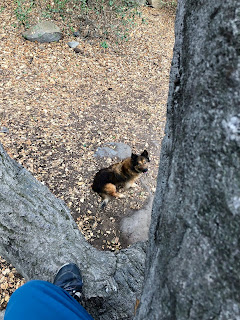
A tree invites me
Climb. We embrace each other
in uncertain times.
I wrote it while on a lovely hike (Thursdays are my work at home day, so I have a bit more time to actually get my feet onto dirt) during which I felt so good that I actually - get this - ran a little bit. I can't tell you how long it's been since that happened. And as I was jogging along, feeling pretty good, it suddenly hit me - I was feeling pretty good! And then it hit me - that must mean that I've been feeling pretty not-good for a while, you know?
I know that seems like a weird thing to say, but this has happened to me enough times now that I recognize it. It happened during several major bouts of depression, after my back surgery, and, several times now, with RA.
The obvious onset of RA and diagnosis came pretty quickly for me - I was very lucky. In the spring of 2017, I visited Tess at Mount Holyoke, and I remember clearly being able to sit cross-legged on the bed, tuck my leg under me when I sat in a chair, and that I could hunker down to take photos of the ice on the long lake on campus. That was at the end of March. By May, I couldn't do any of those things. By June, and definitely into July, it was becoming so painful to hook and unhook my bra, or to pull a t-shirt off over my head, that I began to worry that I'd have to start asking Rick to help me dress and undress. I also found that if I sat for any length of time, getting up again was... well, let's just say it was really painful, and it took a few minutes for my hips to unkink enough for me to walk without hanging on to something. I felt like an old lady - I'd stand up in restaurants and then just wait, hanging on to the back of my chair, to unfold, creakily, into some position that would let me walk.
And here's where I got lucky. My GP sent me to a fantastic rheumatologist. He asked for the full history of my symptoms, did a physical exam, and told me that even though my bloodwork kept (and still keeps) coming back negative for any of the markers of RA (or any other autoimmune disorder), he was sure it was RA. (As an aside, this is called seronegative RA, and about 30% of cases fall into this category.) He then gave me a ten-day course of steroids as a final diagnostic - if I responded strongly, he considered that an affirmative diagnosis.
And boy howdy, did I respond. The first two days, nothing. And then on day three, I woke up, and people - I felt like I could rule the fucking world.
I say it like that, because that's exactly how I felt. I felt huge and expansive, like I had more energy than I knew what to do with. I could MOVE! I could PUT ON MY CLOTHES! I could THINK! I wanted to start knitting projects, and go on walks, and find new books to read. The list went on and on. I wanted to ride my horse, and paddleboard, and and and...
Now, I'm pretty sure that at least some of that was simply the steroids (I now have a much better understanding of why people get hooked on them, outside of the world of inflammation and pain - I felt fanfuckingtastic! Until the ten-day course ended, when I wanted to die; but that's another story). But I also know that a lot of it was simply the contrast between what I was feeling before, and how I felt on the steroids. I had known, intellectually, that the way I felt wasn't my normal self. But my body and activities had adjusted, in some ways - in an unconscious form of triage, I'd given things up that I hadn't even realized I'd given up. My list of priorities included things like, spending time with my family doing the things they like to do in the summer, taking care of my horse, and keeping up my end of the house-running bargain. That all seemed like a normal summer, but it wasn't. Usually, in the summer, I also exercise, and start new and complicated knitting projects, and think about my classes in the fall, and read books I don't have time to get around to during the year. I'd also wanted to reboot the blog (as you may recall). All of those things fell by the wayside, unnoticed. And I somehow thought I was living my life, because the "real" stuff was getting done.
Until I had enough energy to do all the things I usually do. Wow.
And that's what just happened again. After diagnosis, I started on methotrexate, which is the first-line drug of choice for RA, because it's cheap, and it works for a lot of RA patients. I was on it for a number of months, until we realized that while I could live with the nausea if I absolutely had to, I could not live with the brain fade that stole my mind two days a week - my job requires me to have a brain, and to be able to find words; I'm a linguist, for goodness' sake! I then went on leflunomide, with the goal of seeing how well it worked and then probably adding a quinine derivative. Usually there's a three-drug regimen, but the third is a sulfa drug, and I'm allergic to those, so the goal was to see if the two drugs together could control the symptoms. But when the doctor looked at my joints in February, he wasn't at all happy with the progression of the disease, and he started me on Humira.
This is where I talk, briefly, about how important health insurance is. I absolutely canNOT imagine how people with an illness like this manage without it. I have always been appalled by the lack of universal coverage in this nation, and having RA just makes me even more angry. I am lucky - I have very good insurance, and it authorized my use of Humira, a drug which costs upwards of $24,000 a year. But what about people who don't have insurance, and can't afford that (I couldn't afford that without insurance, and I make a good living)? Doesn't their health and well-being matter to us, as a nation? (I know the answer to that, I just don't like it.) But that's a rant for another day.
In any case, the Humira wasn't perfect, but it seemed to be helping. We'd just decided to give it a full six months before making the call on whether it's the right treatment for me, when I suddenly gained a bunch of weight in a very short time, had swelling in my belly, and began experiencing heart arrhythmias. Which looks a lot like heart failure. Which Humira can cause, in a small subset of people (who knew?). So off the Humira I went for several months, while I waited to see a cardiologist for all kinds of tests. The good news is that my heart looks fine, so the decision was made to try Humira again one more time, and I now have five injections (which means about ten weeks) under my belt.
And (and here's the punchline of this whole thing), I think it finally kicked in last week. Because all of a sudden, I was running a little bit, and not wishing for/taking a nap most days, and I had brain space to think about swatching and casting on for both a sweater AND Kivrin's college blanket (more on that in the knitting round-up post I have planned).
What's weird is, I hadn't even really realized that I wasn't doing any of those things, until I found myself wanting to again. I'd thought I was doing OK - work was getting done, all my to-do list items were getting checked off (or, at least, at my usual rate, which invariably involves moving some tasks from week to week - usually tasks that include a trip to the post office - am I the only one who finds packing things up an getting them to the post office strangely overwhelming?), so I was fine, right?
Guess not. I hadn't realized how much I'd deteriorated, how much energy I was spending managing pain and discomfort and fatigue, until those things lifted, at least most of the way.
In any case, I'm hoping that the very occasional weird heart rate things I'm getting are just that - weird heart rate things. Because it's nice to be able to type this whole post without hurting; it's nice to knit without having to stop every ten minutes for a break; it's nice to take a long walk and maybe even run a little.
It's nice to climb a tree. Which I also did.

A tree invites me
Climb. We embrace each other
in uncertain times.
Thursday, September 20, 2018
Negotiations
I keep trying to figure out how to start these posts. It feels to me, in some ways, like starting in the middle of the story - giving updates on where I am now, presupposing everything that's happened in the last year. At some point, I'll go back and write about how I got here. But not today.
Today, I'm thinking about how I've been learning to negotiate with activities and objects that I really never had to think about before. One interesting aspect of RA, for me, is that, while I'm very lucky and none of my joints has undergone remodeling, they certainly aren't unaffected. They can be uncomfortable quite a bit of the time, and sometimes actively painful. But worse, for me, is that they often feel weak. In a lot of ways, that is the feature of this year that I've had to bring all of my self-compassion and mindfulness to bear on, in order to avoid ruminating and spiraling into worries about a future that hasn't happened yet, and which may never come. I grew up playing piano - my first real job in high school was as a piano teacher. I knit. I spin. I write by hand (and love my fountain pens and Traveller's Notebooks). I ride my horse. I cook. In each of these activities, I have always taken the strength and dexterity of my hands for granted. Up until a year and a half ago, I had never cut myself with a kitchen knife - ever. (And I cook a LOT.) I zested my thumb with a lemon zester once (I don't recommend it), but that's it. And then in the course of two months (February and March 2017), I cut myself twice, once badly enough that we sort of stared at it for a while and wondered whether it needed stitches (especially when it would NOT stop bleeding for half an hour, while I put pressure on it and held my hand over my head). It was so unlike me that I didn't quite know what to make of it - I am not (was not) clumsy with my hands. It wasn't until much later that I put it together, and came to think of it as the first joint-related warning sign that all was not well.
Rereading that, here's the statement that I think captures the emotional tension of the last year:
I am not (was not) clumsy with my hands.
That's a lot to come to grips with. (ha)
One place where I have to do a lot of negotiating is at the barn. The spigot handle of the hose I use to fill Disco's water bucket is often really tight, and the nozzle we've attached to the hose takes me two hands to open up and close again. I have learned to notice the frustration and anger that arise when I struggle with these tasks. Mostly, I manage to take a deep breath, laugh a little, and go back and take it slowly. Mostly.
On days when things hurt, one of the toughest barn jobs is also one of the most ubiquitous - picking out Disco's hooves. This is something that I need to do before and after every ride (and I also do it after turning her out) to make sure she hasn't picked up a stone which would stay lodged in the frog of her hoof, or under the shoe - that's uncomfortable, and not so good for her. It also gives me a chance to check her shoes, and the condition of her hooves, and how her feet and legs are doing. But hoof picking is a tough task. It involves bending over, picking up a hoof, and holding it while I dig out anything that's gotten stuck in there. D's pretty good about it - she picks up her hooves politely when asked (she even anticipates which hoof is next), but she doesn't do all the work of holding them up, and, lacking fingers and wrists, she can't do the digging out part (that's my job).
 That's her back right hoof. I'm facing backwards, with my right shoulder against her right back leg. I usually hold her hoof up with my right hand, but (in the interests of trying to take a picture), I'm holding her leg up between my knees, and the camera is in my right hand. I hold the pick with my thumb on top and fingers on the bottom - the circle shows the pick itself, and the arrow is the direction it's moving. The goal is to get all of the dirt (and whatever it's hiding) out of there.
For fun, I also took a video of what this looks like. But my main point here is that this job works my back, both wrists (one to hold up the hoof, the other to pick), and especially the thumb joint and wrist (which has to use a rotational movement to get the job done) of the picking hand. And I get to do this eight times (one for each hoof before and after riding) whenever I get out there.
At the same time, I'm aware of how good for me my time with Disco is. Physically, it motivates me to keep moving - and believe me, riding a horse like her in the ways that we ride takes focus, concentration, and a lot of physical work. Emotionally and spiritually - well, there's nothing like spending time with a half-ton dance partner to ground and uplift at the same time.
All of this captures an interesting tension that exists for me at this stage of the disease. On the one hand, I am feeling and living the things that are harder for me, or that I have to negotiate differently than I have in the past - and I am sometimes feeling that as a loss. On the other hand, I am keenly aware that I haven't (yet?) had to give up anything, and that I am so very lucky to have that be true, and to have Disco (among other things and beings) to motivate me to keep it that way. I'm guessing that I'm not at all alone in living that tension, or in understanding the importance of finding and embracing those motivators.
And speaking of motivators - here's another one, with something to celebrate. Kivrin, my 17-year-old high school senior, got her license on Tuesday! She's happy, and I'm happy for her (and for me, as you might imagine).
 You go, girl!
Today, I'm thinking about how I've been learning to negotiate with activities and objects that I really never had to think about before. One interesting aspect of RA, for me, is that, while I'm very lucky and none of my joints has undergone remodeling, they certainly aren't unaffected. They can be uncomfortable quite a bit of the time, and sometimes actively painful. But worse, for me, is that they often feel weak. In a lot of ways, that is the feature of this year that I've had to bring all of my self-compassion and mindfulness to bear on, in order to avoid ruminating and spiraling into worries about a future that hasn't happened yet, and which may never come. I grew up playing piano - my first real job in high school was as a piano teacher. I knit. I spin. I write by hand (and love my fountain pens and Traveller's Notebooks). I ride my horse. I cook. In each of these activities, I have always taken the strength and dexterity of my hands for granted. Up until a year and a half ago, I had never cut myself with a kitchen knife - ever. (And I cook a LOT.) I zested my thumb with a lemon zester once (I don't recommend it), but that's it. And then in the course of two months (February and March 2017), I cut myself twice, once badly enough that we sort of stared at it for a while and wondered whether it needed stitches (especially when it would NOT stop bleeding for half an hour, while I put pressure on it and held my hand over my head). It was so unlike me that I didn't quite know what to make of it - I am not (was not) clumsy with my hands. It wasn't until much later that I put it together, and came to think of it as the first joint-related warning sign that all was not well.
Rereading that, here's the statement that I think captures the emotional tension of the last year:
I am not (was not) clumsy with my hands.
That's a lot to come to grips with. (ha)
One place where I have to do a lot of negotiating is at the barn. The spigot handle of the hose I use to fill Disco's water bucket is often really tight, and the nozzle we've attached to the hose takes me two hands to open up and close again. I have learned to notice the frustration and anger that arise when I struggle with these tasks. Mostly, I manage to take a deep breath, laugh a little, and go back and take it slowly. Mostly.
On days when things hurt, one of the toughest barn jobs is also one of the most ubiquitous - picking out Disco's hooves. This is something that I need to do before and after every ride (and I also do it after turning her out) to make sure she hasn't picked up a stone which would stay lodged in the frog of her hoof, or under the shoe - that's uncomfortable, and not so good for her. It also gives me a chance to check her shoes, and the condition of her hooves, and how her feet and legs are doing. But hoof picking is a tough task. It involves bending over, picking up a hoof, and holding it while I dig out anything that's gotten stuck in there. D's pretty good about it - she picks up her hooves politely when asked (she even anticipates which hoof is next), but she doesn't do all the work of holding them up, and, lacking fingers and wrists, she can't do the digging out part (that's my job).

At the same time, I'm aware of how good for me my time with Disco is. Physically, it motivates me to keep moving - and believe me, riding a horse like her in the ways that we ride takes focus, concentration, and a lot of physical work. Emotionally and spiritually - well, there's nothing like spending time with a half-ton dance partner to ground and uplift at the same time.
All of this captures an interesting tension that exists for me at this stage of the disease. On the one hand, I am feeling and living the things that are harder for me, or that I have to negotiate differently than I have in the past - and I am sometimes feeling that as a loss. On the other hand, I am keenly aware that I haven't (yet?) had to give up anything, and that I am so very lucky to have that be true, and to have Disco (among other things and beings) to motivate me to keep it that way. I'm guessing that I'm not at all alone in living that tension, or in understanding the importance of finding and embracing those motivators.
And speaking of motivators - here's another one, with something to celebrate. Kivrin, my 17-year-old high school senior, got her license on Tuesday! She's happy, and I'm happy for her (and for me, as you might imagine).

Tuesday, September 11, 2018
And back again!
I’ve been
wondering why I didn’t formally shut down the blog and say goodbye to it. I was ready to, last February, when I hadn’t
written another post in a while, and was feeling pressure to do so. At the time, as I contemplated actually
stating to the world that this phase of my life is done, I felt relief. There were a lot of reasons for that. One was that I felt (and I still feel) that I
maybe have something bigger to write, and that I wasn’t getting to that. Frankly, I was also feeling overwhelmed by
everything that was on my plate, and the nagging sense that the blog was there,
needing to be fed and watered, didn’t help.
Without
fully articulating it, I think I also had, and have, the feeling that I’m going
somewhere else in my life, and that, while writing about knitting isn’t
something I never want to do again, the mulling thoughts that want to come out
of my fingers and onto the page, the conversations that I want to have with
other people – those are much less about knitting right now, and more about
other things. And that’s kind of
scary. This is, after all, the blog of
the knitting linguist. And if I’m not
writing about knitting or linguistics… I was about to say that I worry about
alienating people who came here to read about knitting, but what am I talking
about? This blog has been essentially
defunct for some time!
But last
week, I had an experience that really made me want to write about it, even if
no-one actually ends up reading it. And
it made me realize that at least one answer to the question of: if this is not
the blog of the knitting linguist, what is it?
Is: the blog of the knitting linguist, this time with RA. Of course, that’s only one answer to that
question, but it’s a relevant one.
I think
I’ve said before that, last summer, I was diagnosed with rheumatoid
arthritis. A lot of other weird things
happened last summer, too, but that one’s been a bit of a focus this year. I’ll talk more in another post about how that
diagnosis came about, and about how lucky I am that it happened as early as it
did in the course of the disease, but for now I’ll just say it’s not raging out
of control, but neither is it really under control, which is an interesting
liminal state to be in. It means that
there are times when I feel that I am not quite as able to do the things that I
was able to do a year and a half ago.
And when that happens, and I feel the cold wind of “what will this be
like next year”, that I come face to face with a very different kind of
understanding about access and ability and difference.
This time,
it hit me in a surf shop. One thing I
have been wishing I could do is to swim more in the ocean. And by “swim more”, I mean “swim at
all”. The ocean has felt too cold to me
to swim in for some time. Call me a
wimp, call me temperature sensitive, call me whatever you want, but while I’m
happy to walk along the beach, and (depending on the season) get my feet wet
looking at tide pools, I haven’t gotten in to swim in a very long time. I particularly, this summer, began to wish
quite strongly that I could snorkel. So
we rented wetsuits and snorkeled in La Jolla a few weeks ago, and I was delighted. A wet suit changes everything! Who knew?
I’ve been
putting off going into a surf shop to try on wet suits – that’s a whole lot of
decision-making and choosing, and I wasn’t motivated to get it done. But we
drove by one with a big Labor Day sale sign out front, and Rick pulled into the
parking lot, and there we were. So, we
found some suits that looked like they might work, and off I went into the
dressing room. Where I found the first
indication that I am really not represented in Wet Suit Land:

I’m
nowhere to be seen on that chart. I’m a
titch over 5’2”, and I usually weigh somewhere between 136 and 142. My measurements are, loosely, 36-30-41. Check out that chart again. Apparently, to weigh what I weigh, I’m
supposed to be five inches taller. I
mean, I know that neoprene is stretchy, but honestly, people. Rick’s not on that chart, either (he’s 6’6”),
nor is my niece, who is tall and very lean.
All I’m saying is it doesn’t make a girl feel warm and fuzzy.
But that
isn’t even why I’m writing this – I’m so used to not being represented in
clothes sizes that I’m pretty inured to that reality. Nope.
What really hit me is that wetsuits are just not made to be easy to get
into. I know that they need to fit
tightly in order to serve their function.
But I can’t tell you how hard it is to pull skin-tight stretchy neoprene
up and down arms and legs with hands and wrists that are (even minimally – and
imagine for folks whose RA has gone further than mine) weak and painful, with
tender joints. This is made much worse
by the way the suits are built. The ones
I tried on first had back zippers. That could
be good for access, but those zippers are short, ending well above my waist,
which means that the tightest part of the wetsuit (the waist) has to come up
over the widest part of my body (the hips; see above), without an opening to
help it along. And then we discovered
that most of the newer suits have, instead of a back zipper, a zipper that runs
along the front left collarbone. This
means that the whole, skintight suit is like a body suit, with the only opening
being the one at the top. This is FAR
more inaccessible than the already-difficult short back zipper.
And all I
could think was, how do people who hurt more than I do, have more weakness than
I do, have less mobility than I do – how do they do it? Or is it assumed that they do not? That they don’t want to get into the big
blue? Because I guarantee that some of
them do. Maybe the assumption is that
dealing with being cold is the price of swimming with disability. But for me, at least, the cold would make
everything worse. It would kick off my
Reynaud’s, cool my joints and make them less mobile and responsive, and
generally hurt. This wetsuit is going to
make it possible for me to swim at all in the cooler water. (And note, I’m not talking about really cold
water. When we snorkeled in La Jolla,
the water was 74 degrees, and even with a wetsuit, I was chilly at times.)
Trying on
four wetsuits was enough to slow me down for the rest of the day. Typing this took up the last of what my
wrists could do that day.
None of
this is to say that I didn’t know that mobility is a presumed feature of
life. I spent a lot of time with our
grandmom as she aged, and was acutely aware of the way that the structure of
many places made it difficult for her to get around. And was also acutely aware of how frustrating
and embarrassing that was for her. I
have had students with disabilities both visible and invisible. Moving around campus with them has been an
experience in frustration, in seeing the degree to which they had to plan each
move of their day so as to get to class on time, get food between classes,
access the bathroom, access space in the classroom. Those experiences made me careful not to
judge someone who seemed to me to be moving more slowly than I’d expect, using
the elevator for one floor, taking out a parking placard. It also made me aware of how invisible those
access difficulties are to most members of my community.
As we all
know, knowing about something is one thing, but living it, even just the edges
of it, is different. It’s interesting,
and frustrating in a new way, to be inside the edges of this problem, instead
of walking alongside someone while seeing it from the outside. It’s a good reminder of how important
first-person narratives are, of how critical a range of voices can be in any
discussion.
It also
makes me think that somebody should be able to design a wetsuit that’s not so
bloody difficult to get into! (ETA:
Someone did. They ain’t cheap.)
Subscribe to:
Posts (Atom)
